Remofirst vs Multiplier (2026): What Does $260 More a Month Buy?
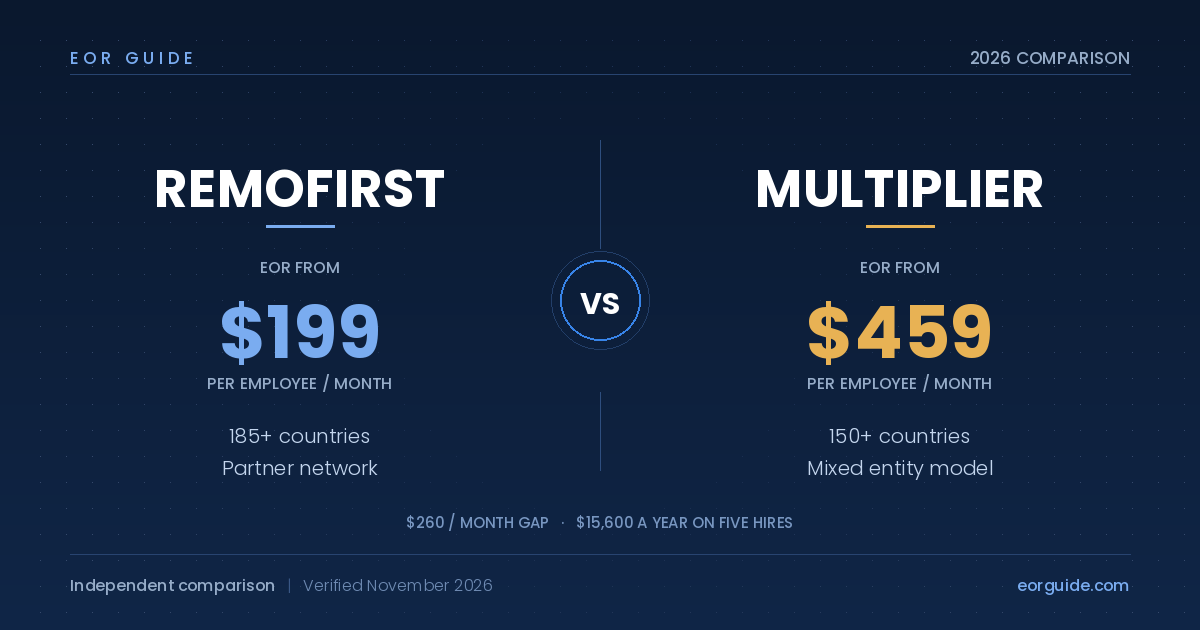
If you are weighing Remofirst vs Multiplier, you are comparing two providers that look similar on paper and differ by 2.3× in price. Remofirst lists EOR at $199 per employee per month. Multiplier lists $459 billed annually, or $499 month to month.
That is $260 more per employee, every month — $3,120 a year on one hire, $15,600 on five, $31,200 on ten.
Here is what makes this comparison genuinely interesting: neither provider offers the thing that usually justifies a premium. Remofirst operates primarily through local partners. Multiplier operates a mixed model and does not publish which countries are owned versus partner. Only Remote runs 100% owned entities, and it charges $699.
So the Remofirst vs Multiplier decision is not “cheap versus safe.” Both carry partner-model risk. The question is narrower and more useful: what does the extra $260 actually buy?
Quick verdict on Remofirst vs Multiplier: Choose Remofirst if you are making one to five hires in established markets and budget is your binding constraint. Choose Multiplier if your hiring is Asia-Pacific weighted, you need real integrations, or you are past roughly ten international employees.
Remofirst vs Multiplier: Side-by-Side
| Remofirst | Multiplier | |
|---|---|---|
| EOR price | From $199/employee/month | $459 (annual) · $499 (monthly) |
| Higher tier | — | Growth: $519 · $559 |
| Contractor management | Free tier; $25/month for payments | $40/month (annual) · $49 (monthly) |
| Contractor of Record | Not offered | $400/contractor/month |
| Global payroll | Not a core product | From $20/employee/month |
| Country coverage | 185+ | 150+ |
| Entity model | Partner network | Mixed — breakdown not published |
| Security deposit | Not published — ask | Refundable, sized at Multiplier’s discretion |
| Setup / termination fees | None | None |
| Integrations | BambooHR, ADP Workforce Now | 10+ including Workday, NetSuite-adjacent, Okta, plus public API |
| Visa & immigration | RemoVisa, 85+ countries | Included, timelines vary |
| Billing currencies | USD | USD, SGD, AUD, EUR, GBP |
Pricing verified November 2026 against the Remofirst pricing page and Multiplier’s published EOR costs. Platform fees only — salary, employer taxes and statutory contributions are additional.
Remofirst vs Multiplier Pricing: The $260 Gap
Before comparing the two numbers, one correction worth making: most comparison content still quotes Multiplier at $400. That figure is out of date. Multiplier moved to tiered pricing during 2026, and $400 is now its Contractor of Record rate, not its EOR rate. We verified the change in November 2026.
So the real Remofirst vs Multiplier gap is $260, not $201.
What that gap looks like in practice:
| Team size | Remofirst/year | Multiplier/year | Difference |
|---|---|---|---|
| 1 employee | $2,388 | $5,508 | $3,120 |
| 5 employees | $11,940 | $27,540 | $15,600 |
| 10 employees | $23,880 | $55,080 | $31,200 |
But platform fees are the smallest part of your bill. Employer taxes and statutory contributions add 13–40% on top of salary depending on country. On five $70,000 hires, that is $45,500 to $140,000 annually. Against that, $15,600 is real money but not the dominant line item.
Two things neither provider publishes clearly. Remofirst’s rate is “from $199” and may vary by country. Multiplier applies adjusted pricing in roughly 11% of markets and now shows “+ Compliance mandated add-ons” on its pricing cards with no amount attached. Get a written quote naming your specific countries from both.
Contractors flip the comparison. If you run contractors rather than employees, Remofirst wins clearly: a free tier covering onboarding, contracts and expense reimbursement, rising to $25 per contractor only once Remofirst processes payments. Multiplier charges $40 from the start. On fifteen contractors that is a $225-a-month difference in Remofirst’s favour.
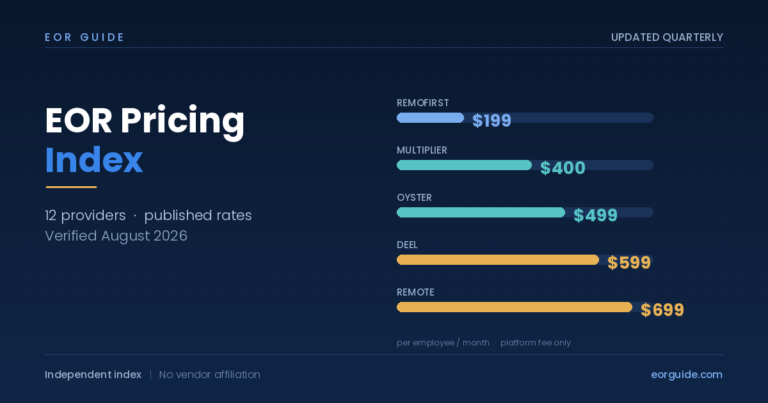
For current rates across the wider market, see our EOR Pricing Index.
The Entity Model: Where Remofirst vs Multiplier Actually Differs
This is the part most comparisons get wrong, and it is where the $260 partly goes.
Remofirst is openly a partner network. A local partner acts as the employing entity in most markets. This is what allows 185+ countries at $199 without the capital cost of incorporating everywhere. It is a legitimate model and it is honestly described.
Multiplier runs a mixed model — owned entities in core markets, partners elsewhere. It claims owned entities across a wide footprint but does not publish the country-by-country breakdown. Independent trackers have identified a limited number of named legal entities, heavily concentrated in Asia.
Why this matters more than coverage counts. With an owned entity, your provider is the legal employer and carries liability directly. With a partner, a third-party firm holds that relationship, and your onboarding speed, service quality and dispute resolution all depend on them. Multiplier users report onboarding in under 24 hours in owned markets versus 7–10 days in partner markets like Brazil.
The practical test for any Remofirst vs Multiplier decision: ask both providers, in writing, who the legal employer is in each country on your hiring list. If Multiplier’s answer is “partner” in your markets, you are paying $260 more for the same structure Remofirst provides. If it is “owned,” the premium is defensible.
Note the coverage figures cut against the price: Remofirst advertises more countries (185+ versus 150+) at less than half the cost. Country counts are close to meaningless as published — a partner-model provider counts a country the moment it signs a partner there.
What the Extra $260 Genuinely Buys
Setting the entity question aside, a fair Remofirst vs Multiplier assessment has to credit what the premium delivers. Multiplier does deliver things Remofirst does not.
Asia-Pacific depth. Multiplier was founded in Singapore in 2020 and its owned-entity footprint is deepest in Singapore, India, the Philippines and Australia. If your hiring is APAC-weighted, this is the clearest reason to pay more, and it is substantive rather than marketing.
Integrations. Remofirst supports BambooHR and ADP Workforce Now, then CSV exports. Multiplier connects to QuickBooks, Xero, BambooHR, HiBob, Workday, SAP SuccessFactors, Oracle, Google Workspace, Slack and Okta, with a public API. Below ten employees this costs you nothing. Past fifteen or twenty, manual reconciliation starts consuming more finance hours than the fee saved.
Multi-currency billing. Multiplier bills in USD, SGD, AUD, EUR and GBP. Useful if you are not a US company.
Adjacent products. Contractor of Record for misclassification protection, and global payroll from $20 per employee per month if you have your own entities. Remofirst offers neither.
Track record and scale. Multiplier has raised $77.2 million from Tiger Global, Sequoia Capital India and DST Global, holds 4.7 on G2 across 1,374 reviews, and was named a Leader in NelsonHall’s NEAT evaluation for Global EOR Services in September 2025. Remofirst is younger with a shorter documented record. Both are legitimate — see Is Multiplier Legit? and Is Remofirst Legit? for the full assessments.
An AI compliance tool. Multiplier launched a classification-risk advisor in 2026. Genuinely useful if you run a mixed contractor and employee base.
Where Remofirst Wins Outright
On five of the criteria in this Remofirst vs Multiplier comparison, the cheaper provider is simply better.
Price, obviously. Less than half, with no tier structure to navigate.
Contractor management. A free tier beats $40 a month, and most early-stage companies start with contractors.
Country coverage on paper. 185+ versus 150+.
No deposit complexity. Multiplier’s refundable deposit is sized at its own discretion under terms effective June 2026. Remofirst does not publish a deposit requirement. For a pre-seed company, tied-up working capital can matter more than the monthly fee.
Simplicity. A clean single-purpose tool. If you have five international employees and reconcile payroll in a spreadsheet, Multiplier’s extra capability is capability you will not use.
Where Multiplier Wins Outright
APAC execution — the strongest single argument for paying more.
Integration depth — not close.
Onboarding speed in owned markets — often under 24 hours.
Product breadth — Contractor of Record and global payroll have no Remofirst equivalent.
Independent recognition — the NelsonHall Leader placement is unusual at this price point.
Remofirst vs Multiplier: Which Should You Choose?
Choose Remofirst if:
- You are making one to five international hires
- Budget is a genuine constraint and $15,600 funds something else
- You are hiring into established markets with straightforward employment law
- You run contractors as well as employees and want the free tier
- Your HR stack is simple, or you already use BambooHR
- You want to avoid a discretionary deposit
Choose Multiplier if:
- Your hiring is Asia-Pacific weighted — Singapore, India, the Philippines, Australia
- You expect to pass ten to fifteen international employees within a year
- You run a real tech stack where integration gaps create manual work
- You need Contractor of Record protection or global payroll alongside EOR
- You are not a US company and multi-currency billing matters
- You want the more established of the two
Remofirst vs Multiplier FAQ
Is Multiplier really worth more than twice Remofirst’s price?
It depends almost entirely on where you hire and how many. For APAC-concentrated hiring above ten employees with real systems behind it, yes. For three hires in Western Europe with a simple stack, the $260 buys capability you will not use.
Which has better country coverage?
Remofirst advertises more — 185+ versus 150+. But both count partner-reached countries, so the figures are not comparable to an owned-entity provider’s. Compare entity models in your specific markets, not totals.
Is Remofirst less compliant because it uses partners?
No. Remofirst generates locally compliant contracts and remits statutory obligations. The structural point is that execution depends on the local partner rather than Remofirst directly — and the same applies to Multiplier in its partner markets.
Which is better for contractors?
Remofirst, clearly. Its free tier covers onboarding, contracts and expense reimbursement, rising to $25 per contractor only when it processes payments. Multiplier charges $40 from the start.
Can I start on Remofirst and switch later?
Yes. Neither requires an annual contract or charges termination fees. Switching means re-onboarding employees under a new legal employer — administratively real but routine. Starting cheap and migrating at scale is a defensible strategy.
What about Deel and Remote?
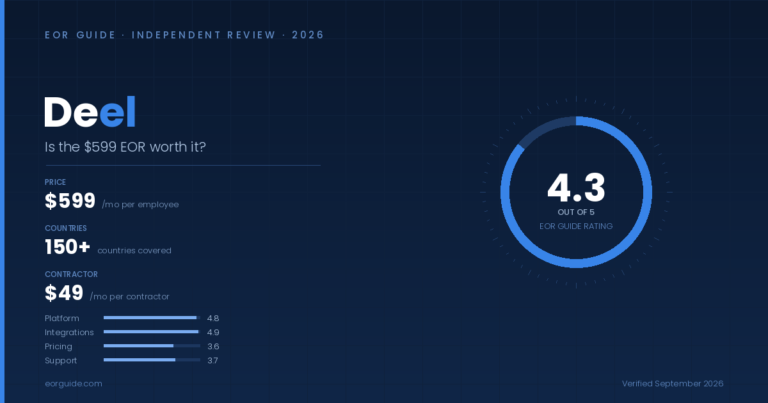
Both sit above this comparison. Deel is $599 with far deeper integrations; Remote is $699 monthly with 100% owned entities. If owned-entity certainty is non-negotiable, neither Remofirst nor Multiplier fully delivers it. See our Remofirst vs Deel comparison.
The Bottom Line
The Remofirst vs Multiplier choice comes down to a question most comparisons skip: are you paying the premium for something you will actually use?
Remofirst is the correct answer for early-stage companies hiring a handful of people in straightforward markets. It is a serious EOR at a price nobody in its tier matches, and the free contractor tier is a real advantage.
Multiplier is the correct answer once Asia-Pacific depth, integrations or product breadth become operationally relevant. It is the more mature platform and the recognition it has earned is genuine.
What should decide it is not the headline gap. Get written quotes from both covering your actual countries, and make each one state the entity model, the FX spread, any country surcharge and any deposit requirement explicitly. In a Remofirst vs Multiplier comparison where both providers depend partly on local partners, who the legal employer is in your markets matters more than $260.
For deeper assessments, read our full Remofirst review and Multiplier review. Our review methodology explains how we assess every provider.
EOR Guide Editorial Team. Pricing and feature information verified November 2026 against provider pricing pages and independent trackers. Vendor terms change frequently — confirm current rates directly before purchasing. EOR Guide may earn a commission from providers featured on this page. This does not influence our assessments.