EOR Pricing Index 2026: What 12 Providers Really Charge
Most EOR pricing pages are published by companies that sell EOR. That is not a small problem. When a provider charging $199 builds the comparison table, the table tends to conclude that $199 is the right price.
This index is different in two ways. First, we do not currently hold an affiliate relationship with any provider listed. Second, we label how each figure was obtained — published on the vendor’s own pricing page, reported by third parties, or available only on request — because in this market those are very different levels of confidence, and most comparisons blur them.
We update this EOR pricing index quarterly and log every change we find. Prices in this category move more than buyers expect.
Last verified: August 2026 Next scheduled update: November 2026
The EOR Pricing Index
| Provider | EOR / employee / month | Contractor / month | Countries | Entity model | Source |
|---|---|---|---|---|---|
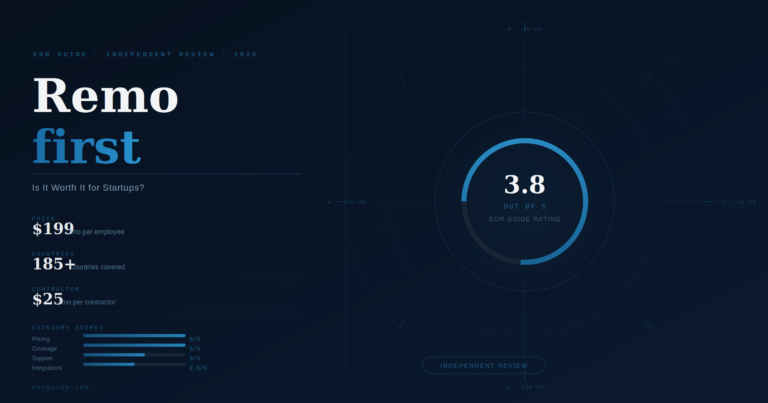
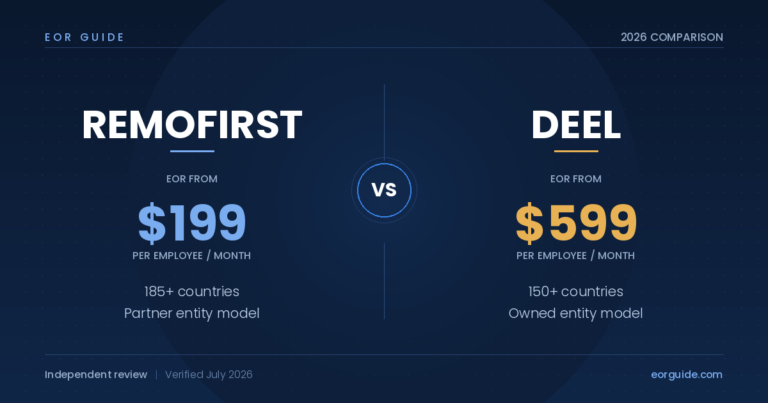
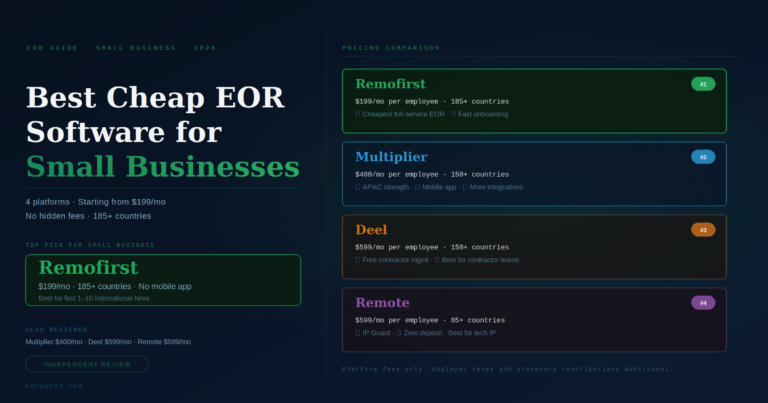
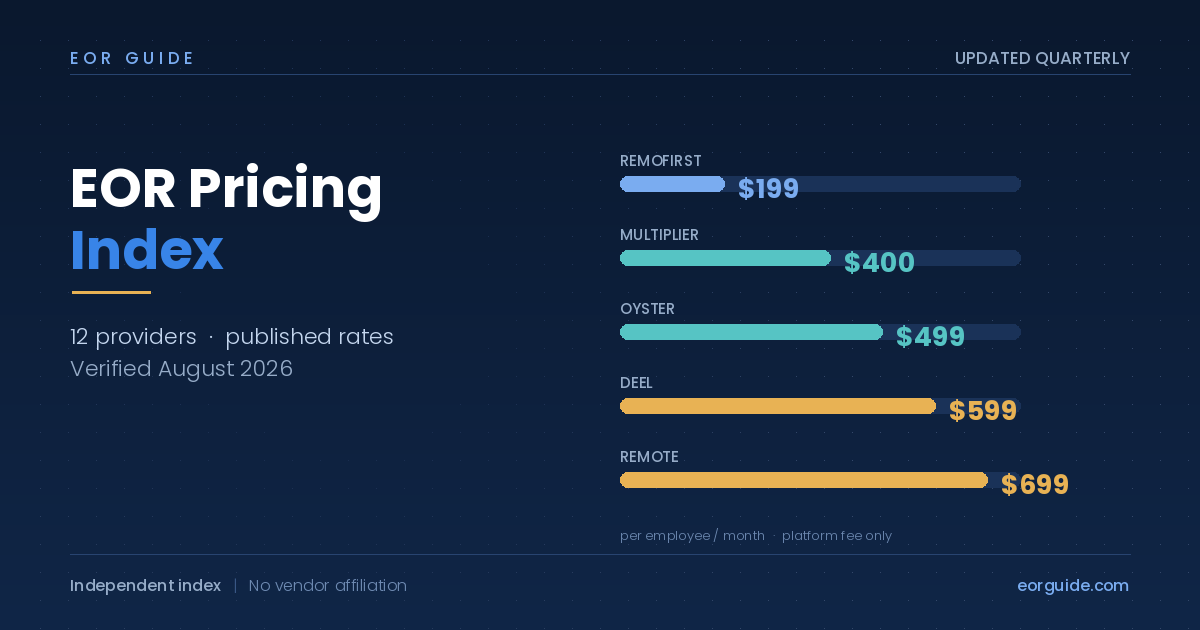
| Remofirst | $199 | Free tier; $25 paid | 185+ | Partner network | Published |
| Skuad | $199 | Not published | 160+ | Partner network | Reported |
| RemotePeople | $199 | Not published | 150+ | Partner network | Published |
| Multiplier | $400 | $40 | 150+ | Mixed | Published |
| Oyster | From $499 | $29 | 180+ | Mixed | Published |
| Rippling | $499–$599 + $8 base | Not published | 140+ | Mixed | Reported |
| Papaya Global | $499–$770 | Not published | 160+ | Mixed | Published (range) |
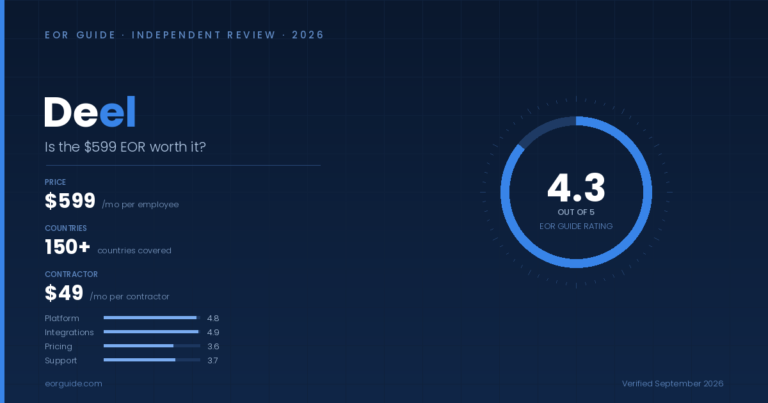
| Deel | $599 standard; $899 enterprise | $49 | 150+ | Majority owned | Published |
| Remote | $699 monthly; $599 annual | $29 | 90+ | 100% owned | Published |
| Omnipresent | From £499 | Not published | 160+ | Mixed | Published |
| G-P (Globalization Partners) | Quote only | Quote only | 180+ | Owned | On request |
| Velocity Global | Quote only | Quote only | 185+ | Mixed | On request |
Source key. Published means the figure appears on the provider’s own pricing page or support documentation. Reported means it comes from third-party analysis or a vendor blog rather than a primary pricing page. On request means no public figure exists.
All figures are platform fees only. They exclude salary, employer taxes, and statutory benefits.
What Changed This Quarter
This is the section most EOR pricing comparisons omit, and it is the one that tells you the most.
Remote moved to $699. Remote’s support documentation now states a standard rate of $699 per employee per month billed monthly, with $599 available on an annual commitment. Many comparison tables — including, until recently, one of ours — still list $599 as the flat rate. If you are budgeting monthly, the correct number is $699.
Deel introduced a two-tier structure. Deel now lists $599 standard and $899 for enterprise, where earlier in 2026 a single $599 figure was more commonly cited.
The budget tier held at $199. Remofirst, Skuad, and RemotePeople all remain at $199. This price point has proved stable across 2026 and now functions as an effective market floor.
Rippling still publishes nothing. Rippling’s EOR rate does not appear on its primary pricing pages. Figures in the $499–$599 range come from Rippling-owned blog content and third-party estimates. Treat it as quote-only.
Four Things This EOR Pricing Data Shows
1. The spread is roughly 3.5x, and it is not explained by quality.
From $199 to $699 in published rates. Remofirst at $199 and Remote at $699 both employ people compliantly in most major markets. What separates them is entity ownership, integration depth, and support maturity — not whether the employment is legally sound.
2. Country counts are close to meaningless as published.
Remofirst lists 185+ countries and Remote lists 90+, yet Remote costs three and a half times more. The difference is that Remote owns entities in every market it serves, while wide-coverage providers reach most countries through local partners. A partner-model provider counts a country the moment it signs a partner there. Compare entity models, not country totals.
3. The platform fee is the minority of your cost.
Employer taxes and statutory contributions typically add 13–40% on top of salary, depending on country. On a $70,000 hire, that is $9,100–$28,000 annually. Against that, the difference between a $199 and a $599 platform fee is $4,800 a year — real money, but smaller than most buyers assume when they anchor on the headline rate.
4. Three of twelve providers publish nothing.
G-P, Velocity Global, and effectively Rippling require a conversation before you see a number. That is a legitimate enterprise sales model, but it means published EOR pricing comparisons covering these vendors are working from estimates. We have marked them rather than inventing figures.
What the EOR Pricing Figure Excludes
Every number in the index above is a platform fee. Your actual invoice includes:
Salary. Paid in local currency, converted at the provider’s rate.
Employer taxes and statutory contributions. Social security, pension, health, unemployment insurance. Ranges from roughly 13% of salary in some markets to over 40% in parts of Western Europe and Latin America.
FX spread. Providers convert your funds to local currency and take a margin. Deel discloses 0.6–2%. Most others do not publish a figure at all. On $500,000 of annual payroll, a 2% spread is $10,000 — enough to reverse the ranking between two providers whose platform fees differ by $200 a month.
Security deposits. Deel requires a refundable deposit of roughly one to one and a half times monthly cost per employee, higher in some markets. Remote and Remofirst do not. This does not change total cost but it does tie up working capital, which matters at early stage.
Country surcharges. Complex markets can carry surcharges above the base rate. Providers rarely publish these. Ask for a written quote naming your specific countries.
Implementation fees. Mostly absent in the pure-play EOR tier, but platform-led providers can charge setup fees running into five figures for complex integrations.
How We Verify This EOR Pricing Index
We check each provider’s public pricing page and support documentation, record the figure and the date, and label the confidence level. Where a provider publishes a range or a country-dependent rate, we report the range rather than picking a convenient midpoint.
We do not accept vendor-supplied figures without a public source. We do not estimate quote-only pricing. Where third-party reports conflict, we say so.
If you are a provider and a figure here is wrong or out of date, email partnerships@eorguide.com with a link to your current pricing page and we will correct it within five business days.
Journalists and analysts are welcome to cite this EOR pricing index with a link. If you need the underlying data in another format, get in touch.
EOR Pricing FAQ
What is the average EOR cost per employee?
Published rates cluster in two bands: roughly $199 for budget providers and $400–$699 for mid-market and platform-led providers. Enterprise pricing runs higher and is generally quote-only. There is no meaningful single average, because the distribution is bimodal rather than centred.
Why do EOR prices vary so much?
Three factors. Entity ownership — running your own legal entity in a country costs $50,000–$150,000 a year before the first hire, and providers who do this charge for it. Platform depth — integrations, HRIS, and API access cost money to build. Support model — dedicated account management is more expensive than shared support queues.
Is the cheapest EOR compliant?
Generally yes. Budget providers at $199 generate locally compliant contracts and remit statutory obligations. The difference is that they usually do so through local partners rather than owned entities, which means your service quality varies by market and there is an additional party between you and any dispute resolution.
How often does EOR pricing change?
More often than the market assumes. We logged two material changes in the last quarter alone. Any EOR pricing comparison without a verification date should be treated as unreliable.
Can I negotiate EOR pricing?
Yes, and most buyers do not try. Published rates are list prices. Volume discounts typically begin around 10–20 employees, with reported negotiated rates well below list at that scale. FX spread is also negotiable and rarely raised by buyers.
The Bottom Line
The most useful thing this EOR pricing index shows is not which provider is cheapest. It is that the published number is the smallest variable in your decision.
A $400 monthly difference in platform fee is $4,800 a year per employee. A 2% FX spread on a $500,000 payroll is $10,000. A misclassification finding in a country with aggressive enforcement can run into six figures. The headline rate is the part everyone compares and the part that matters least.
Get written quotes from two or three providers covering your actual countries, and make each one state the FX spread, any country surcharge, and any deposit requirement in writing. That document will tell you more than any EOR pricing comparison, including this one.
For a fuller explanation of what drives total spend, see our guide to how much EOR software costs. For a direct head-to-head at opposite ends of the pricing range, see Remofirst vs Deel. Our review methodology explains how we assess providers.
Compiled by the EOR Guide Editorial Team. Figures verified August 2026 against provider pricing pages, support documentation, and third-party analyses, with confidence levels labelled. EOR Guide holds no affiliate relationship with any provider listed at time of publication. Corrections: partnerships@eorguide.com.