Deel Review 2026: Is the $599 EOR Really Worth It?
Quick Answer: Deel is the most complete global employment platform on the market — 150+ countries, the deepest integration library in the category, and a platform experience competitors have not matched. At $599 per employee per month it is mid-to-premium rather than cheap, and the published rate is a floor rather than a typical price. Independent analysis puts real all-in cost 26–46% above the headline once FX and statutory contributions are counted.
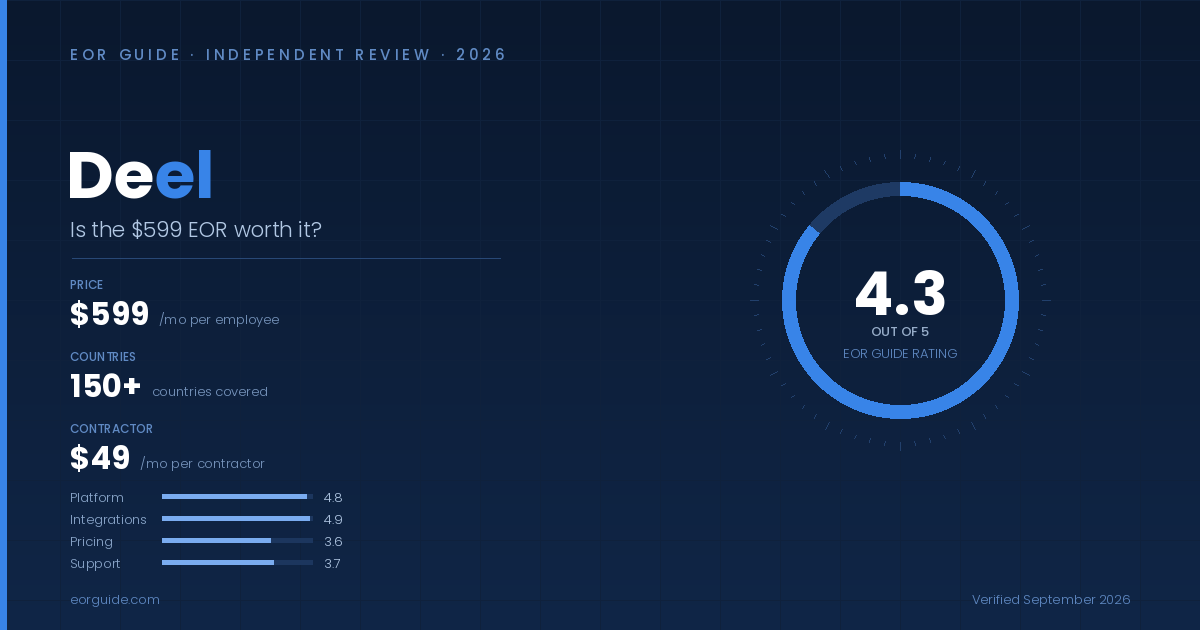
EOR Guide rating: 4.3 / 5
We have published this Deel review without any affiliate relationship with Deel at time of writing.
This Deel review covers pricing and the fees that do not appear on the pricing page, the entity model, platform quality, support, and who should and should not buy it.
Deel at a Glance
| EOR price | $599 per employee/month (Standard) |
| EOR Enterprise | From $899 per employee/month |
| Contractor management | $49 per contractor/month |
| Contractor of Record | $325 per contractor/month |
| Global payroll | $29 per employee/month + $1,000 per-entity setup |
| Country coverage | 150+ |
| Entity model | Mixed — owned and partner entities |
| Security deposit | Approx. 1–1.5x monthly cost per employee |
| Minimum term | Reported as 12 months with auto-renewal |
| Security | SOC 2 Type II |
| G2 rating | 4.5–4.8 across 7,400+ reviews |
| Trustpilot | 3.5–4.0 |
Verified September 2026 against the published Deel pricing page and third-party analyses.
Deel Pricing: What the $599 Does Not Include
The published EOR rate is $599 per employee per month, with an enterprise tier from $899. That number is accurate and it is also incomplete, which is the single most important thing to understand in any Deel review.
Statutory costs dwarf the platform fee. Employer taxes and contributions add 13–40% on top of salary depending on country. Independent analysis puts real all-in cost at 26–46% above the headline figure once FX and statutory obligations are included.
The fees that stack. Deel charges per person and per product. Twenty contractors plus five EOR employees is twenty-five separate seat fees before add-ons. Background checks run roughly $30–$200. Global payroll carries a $1,000 one-time setup per entity.
Funding charges. Card funding is reported at 2.9% + $0.30 for US and EU cards and 3.9% + $0.30 for others. FX conversion is market-based, and Deel discloses a margin in the 0.6–2% range — more transparency than most competitors offer, but on $500,000 of annual payroll a 2% spread is $10,000.
Late payment. Reported at 0.15% per day, compounding on overdue balances.
Deel HR is not free in the way it is often described. Affiliate content frequently calls Deel HR a free HRIS. The bare-bones layer is included once you already pay for payroll or EOR; standalone tiers are reported at $5 per employee/month for Core and up to $56 for Full. It is a bundled entry tier, not a free standalone product.
Volume discounts are real. Reported negotiated rates reach $400–$500 at twenty or more employees and $350–$400 at fifty-plus. Those require annual billing and headcount commitments, sometimes multi-year.
For how this compares across the category, see our EOR Pricing Index.
The Minimum Term Question
Most Deel review content, including our own earlier coverage, describes Deel as having no minimum contract. Third-party contract analysis reports a 12-month minimum term with auto-renewal and 30 days’ written notice for price changes.
We cannot verify this against Deel’s public pricing page, which does not state contract length. That is itself the point: if you are comparing Deel against a provider offering genuinely monthly terms, get the commitment period in writing rather than assuming flexibility that may not be there.
Country Coverage and the Entity Model
Deel covers 150+ countries — sources variously report 150, 153, 154 and 160 depending on how territories are counted. Coverage is among the broadest of the major providers.
The entity model is where this Deel review has to be careful. Deel is commonly described as owning entities in most of its markets. Independent analysis suggests partner entities in roughly half its markets, and at least one reviewer reports verifying only a small number of Deel-owned entities directly.
Why this matters: with an owned entity, Deel is your employee’s legal employer and carries liability directly. With a partner, a third-party firm holds that relationship and your service quality depends on them. This is the same structural consideration that applies to Remofirst and Multiplier — the difference is that Deel is priced as though it were a fully-owned operation.
Practical step: ask Deel in writing whether it owns the entity in each country you plan to hire in. If the answer is partner in your markets, you are paying premium pricing for the structure a $199 provider offers. If it is owned, the premium is justified.
If entity ownership is non-negotiable, Remote is the only major provider operating 100% owned entities, at $699 monthly or $599 on annual commitment.
Where Deel Is Genuinely Strong
Four things earn Deel its position, and this Deel review rates the first two as best-in-category.
Platform quality. The interface is the best in the category and it is not close. Onboarding flows, document management and reporting are clean and fast. For an HR team living in the tool daily, this is a real advantage that does not show up in feature comparisons.
Integration depth. 100+ tools including BambooHR, Greenhouse, Workday, Xero, NetSuite, Slack and Jira, plus documented API access. No competitor at any price point matches this. If your finance team syncs headcount data automatically, Deel is the only provider that makes it straightforward.
Product breadth. EOR, contractor management, Contractor of Record, global payroll, US payroll, US PEO, equipment provisioning and immigration support from one vendor. For a company that wants a single supplier across its employment stack, nothing else comes close.
Onboarding speed. Three to five business days in most markets.
Compliance tooling. Deel Shield offers misclassification protection for contractors, and Contractor of Record at $325 per contractor per month transfers classification risk to Deel — genuinely useful if you run a large freelance base.
Scale and stability. More than 40,000 customers, $1.4 billion in ARR, profitable for over three years. Whatever else is true, Deel will be there next year.
Where Deel Falls Short
No Deel review is complete without the trade-offs, and there are five worth weighing.
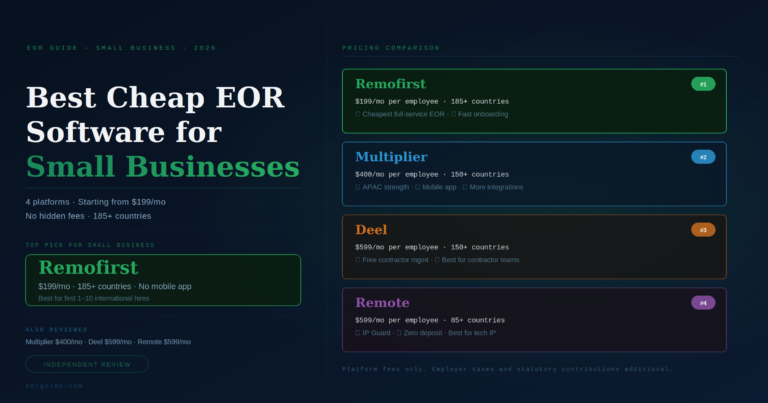
It is no longer the value play. Multiplier at $400 and Remofirst at $199 deliver compliant employment at a fraction of the cost. Deel’s premium buys platform and integrations, not better compliance.
Support degrades at smaller accounts. The most consistent criticism in user reviews. Enterprise accounts report good service; smaller customers report slow responses and inconsistent resolution quality. APAC response times lag US and EU hours.
“From” pricing obscures the real number. $599 is a floor. Country surcharges in complex markets are not published, and the gap between advertised and actual cost is the most common complaint in reviews.
Security deposits tie up cash. Roughly one to one and a half times monthly cost per employee before your first payroll run, higher in some markets. For a seed-stage company that is meaningful working capital.
The Rippling litigation is unresolved. Deel is in active litigation with Rippling over corporate espionage allegations, and a federal criminal investigation was reported in January 2026. Nothing is proven and Deel denies wrongdoing, but if your procurement process includes vendor risk review, it belongs on the list. We cover this fully in Is Deel Legit?
Deel Review: Who Should Buy It
The short version of this Deel review is that fit matters more than price.
Choose Deel if:
- You run a mix of employees and contractors — the combined tooling is unmatched
- Your HR and finance stack is mature and integration gaps would create manual work
- You are hiring across five or more countries and want one vendor
- You need Contractor of Record protection for a large freelance base
- You expect to pass twenty international employees, where volume discounts narrow the price gap
- Platform experience matters to the people using it daily
Look elsewhere if:
- You are making one to five hires and budget is the binding constraint — Remofirst at $199 does the same job compliantly
- Your hiring is APAC-concentrated — Multiplier at $400 has better regional support
- You need owned-entity certainty in every market — Remote is the only fully-owned option
- You need genuinely monthly terms and cannot commit to twelve months
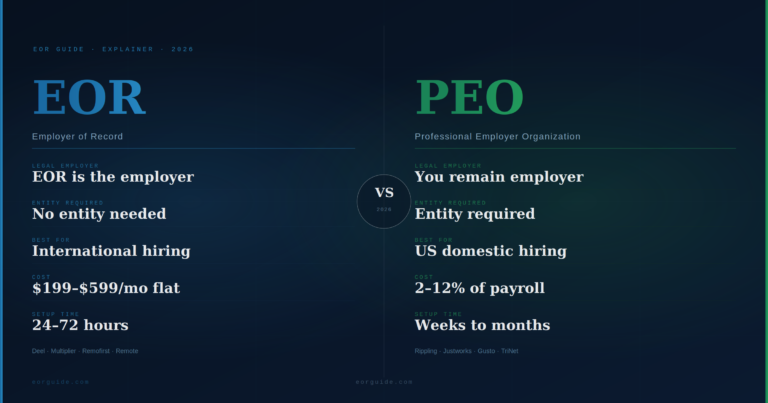
- You are US-only — an EOR is the wrong product entirely
How Deel Compares
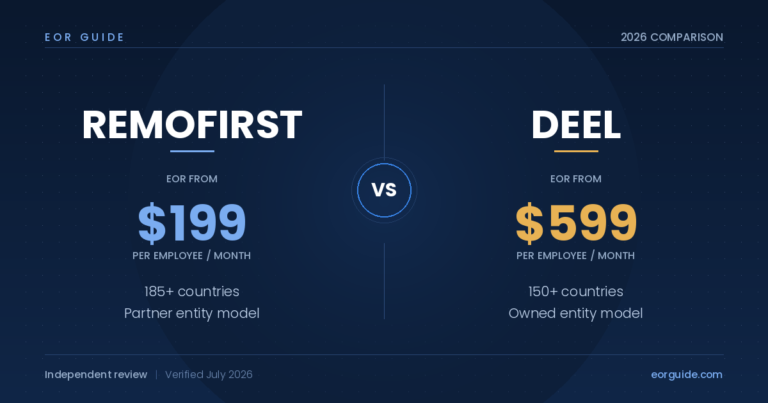
Against Remofirst ($199). Deel costs three times more and delivers platform, integrations and breadth that Remofirst does not attempt. Below five hires with a simple stack, that premium is hard to justify. See Remofirst vs Deel.
Against Multiplier ($400). Multiplier is better value for Asia-Pacific hiring with faster onboarding in owned markets. Deel wins on integrations, breadth and platform polish. Our Multiplier review covers the trade-offs.
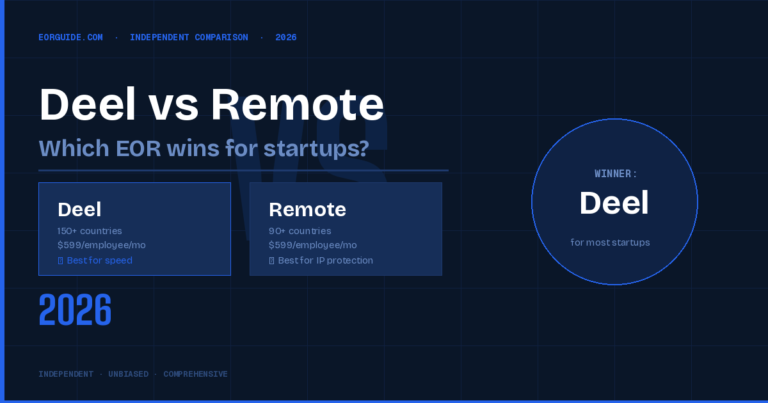
Against Remote ($699 monthly). Remote owns entities everywhere, with no ambiguity. Deel covers far more countries with a mixed model. Compliance certainty versus coverage breadth.
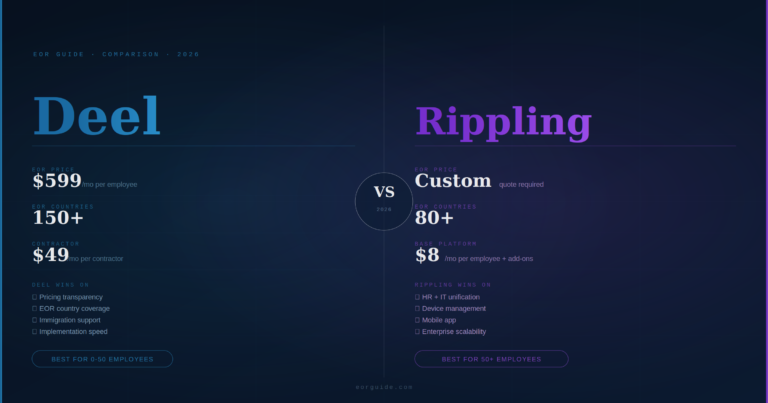
Against Rippling. Rippling unifies HR, IT and finance more tightly, but publishes no EOR pricing and carries implementation fees. See Deel vs Rippling.
Deel Review FAQ
How much does Deel cost?
Published rates are $599 per employee/month for standard EOR, $899+ for enterprise, $49 per contractor/month for contractor management, $325 for Contractor of Record and $29 per employee/month for global payroll plus $1,000 per-entity setup. Real all-in cost runs meaningfully higher.
Is Deel contractor management free?
Sources conflict. Deel’s published rate is $49 per contractor per month, though some recent analyses describe a free unlimited tier. Confirm directly before assuming either.
Does Deel own its legal entities?
In some countries. Independent analysis suggests partner entities in roughly half its markets. Ask for the country-by-country position in writing.
Is Deel worth $599?
For mixed contractor-and-employee teams with mature systems hiring across multiple countries, yes. For a startup making two hires in one country, you are paying for capability you will not use.
Can I negotiate Deel pricing?
Yes, and most buyers do not try. Reported negotiated rates reach $400–$500 at twenty-plus employees, in exchange for annual billing and headcount commitments.
The Bottom Line
Deel is the best global employment platform available, and that is a different claim from being the best value. The platform, integrations and product breadth are genuinely category-leading, and for a company running employees and contractors across several countries with real systems behind it, the premium is defensible.
The honest reservation in this Deel review is the gap between the advertised number and the real one. $599 is a floor, not a price. Add FX, statutory contributions, per-seat stacking, deposits and add-ons, and independent analysis puts total cost 26–46% above the headline. That is not unique to Deel, but Deel is priced as the premium option and should be held to a higher standard of clarity.
Before signing, get four things in writing: the entity model in your specific countries, the FX spread, any country surcharge, and the minimum contract term. Whatever the answers, you will have made a better decision than the published rate alone allows.
Our review methodology explains how we assess every provider.
EOR Guide Editorial Team. Pricing and feature information verified September 2026 against Deel’s published pricing and independent third-party analyses. Where sources conflict, we say so rather than picking a convenient figure. Vendor terms change frequently — confirm current rates before purchasing. EOR Guide may earn a commission from providers featured on this page. This does not influence our assessments or ratings.
Quick Answer: Deel is the most complete global employment platform on the market — 150+ countries, the deepest integration library in the category, and a platform experience competitors have not matched. At $599 per employee per month it is mid-to-premium rather than cheap, and the published rate is a floor rather than a typical price. Independent analysis puts real all-in cost 26–46% above the headline once FX and statutory contributions are counted.
EOR Guide rating: 4.3 / 5
This Deel review covers pricing and the fees that do not appear on the pricing page, the entity model, platform quality, support, and who should and should not buy it.
Deel at a Glance
| EOR price | $599 per employee/month (Standard) |
| EOR Enterprise | From $899 per employee/month |
| Contractor management | $49 per contractor/month |
| Contractor of Record | $325 per contractor/month |
| Global payroll | $29 per employee/month + $1,000 per-entity setup |
| Country coverage | 150+ |
| Entity model | Mixed — owned and partner entities |
| Security deposit | Approx. 1–1.5x monthly cost per employee |
| Minimum term | Reported as 12 months with auto-renewal |
| Security | SOC 2 Type II |
| G2 rating | 4.5–4.8 across 7,400+ reviews |
| Trustpilot | 3.5–4.0 |
Verified September 2026 against the published Deel pricing page and third-party analyses.
Deel Pricing: What the $599 Does Not Include
The published EOR rate is $599 per employee per month, with an enterprise tier from $899. That number is accurate and it is also incomplete, which is the single most important thing to understand in any Deel review.
Statutory costs dwarf the platform fee. Employer taxes and contributions add 13–40% on top of salary depending on country. Independent analysis puts real all-in cost at 26–46% above the headline figure once FX and statutory obligations are included.
The fees that stack. Deel charges per person and per product. Twenty contractors plus five EOR employees is twenty-five separate seat fees before add-ons. Background checks run roughly $30–$200. Global payroll carries a $1,000 one-time setup per entity.
Funding charges. Card funding is reported at 2.9% + $0.30 for US and EU cards and 3.9% + $0.30 for others. FX conversion is market-based, and Deel discloses a margin in the 0.6–2% range — more transparency than most competitors offer, but on $500,000 of annual payroll a 2% spread is $10,000.
Late payment. Reported at 0.15% per day, compounding on overdue balances.
Deel HR is not free in the way it is often described. Affiliate content frequently calls Deel HR a free HRIS. The bare-bones layer is included once you already pay for payroll or EOR; standalone tiers are reported at $5 per employee/month for Core and up to $56 for Full. It is a bundled entry tier, not a free standalone product.
Volume discounts are real. Reported negotiated rates reach $400–$500 at twenty or more employees and $350–$400 at fifty-plus. Those require annual billing and headcount commitments, sometimes multi-year.
For how this compares across the category, see our EOR Pricing Index.
The Minimum Term Question
Most Deel review content, including our own earlier coverage, describes Deel as having no minimum contract. Third-party contract analysis reports a 12-month minimum term with auto-renewal and 30 days’ written notice for price changes.
We cannot verify this against Deel’s public pricing page, which does not state contract length. That is itself the point: if you are comparing Deel against a provider offering genuinely monthly terms, get the commitment period in writing rather than assuming flexibility that may not be there.
Country Coverage and the Entity Model
Deel covers 150+ countries — sources variously report 150, 153, 154 and 160 depending on how territories are counted. Coverage is among the broadest of the major providers.
The entity model is where this Deel review has to be careful. Deel is commonly described as owning entities in most of its markets. Independent analysis suggests partner entities in roughly half its markets, and at least one reviewer reports verifying only a small number of Deel-owned entities directly.
Why this matters: with an owned entity, Deel is your employee’s legal employer and carries liability directly. With a partner, a third-party firm holds that relationship and your service quality depends on them. This is the same structural consideration that applies to Remofirst and Multiplier — the difference is that Deel is priced as though it were a fully-owned operation.
Practical step: ask Deel in writing whether it owns the entity in each country you plan to hire in. If the answer is partner in your markets, you are paying premium pricing for the structure a $199 provider offers. If it is owned, the premium is justified.
If entity ownership is non-negotiable, Remote is the only major provider operating 100% owned entities, at $699 monthly or $599 on annual commitment.
Where Deel Is Genuinely Strong
Platform quality. The interface is the best in the category and it is not close. Onboarding flows, document management and reporting are clean and fast. For an HR team living in the tool daily, this is a real advantage that does not show up in feature comparisons.
Integration depth. 100+ tools including BambooHR, Greenhouse, Workday, Xero, NetSuite, Slack and Jira, plus documented API access. No competitor at any price point matches this. If your finance team syncs headcount data automatically, Deel is the only provider that makes it straightforward.
Product breadth. EOR, contractor management, Contractor of Record, global payroll, US payroll, US PEO, equipment provisioning and immigration support from one vendor. For a company that wants a single supplier across its employment stack, nothing else comes close.
Onboarding speed. Three to five business days in most markets.
Compliance tooling. Deel Shield offers misclassification protection for contractors, and Contractor of Record at $325 per contractor per month transfers classification risk to Deel — genuinely useful if you run a large freelance base.
Scale and stability. More than 40,000 customers, $1.4 billion in ARR, profitable for over three years. Whatever else is true, Deel will be there next year.
Where Deel Falls Short
It is no longer the value play. Multiplier at $400 and Remofirst at $199 deliver compliant employment at a fraction of the cost. Deel’s premium buys platform and integrations, not better compliance.
Support degrades at smaller accounts. The most consistent criticism in user reviews. Enterprise accounts report good service; smaller customers report slow responses and inconsistent resolution quality. APAC response times lag US and EU hours.
“From” pricing obscures the real number. $599 is a floor. Country surcharges in complex markets are not published, and the gap between advertised and actual cost is the most common complaint in reviews.
Security deposits tie up cash. Roughly one to one and a half times monthly cost per employee before your first payroll run, higher in some markets. For a seed-stage company that is meaningful working capital.
The Rippling litigation is unresolved. Deel is in active litigation with Rippling over corporate espionage allegations, and a federal criminal investigation was reported in January 2026. Nothing is proven and Deel denies wrongdoing, but if your procurement process includes vendor risk review, it belongs on the list. We cover this fully in Is Deel Legit?
Deel Review: Who Should Buy It
Choose Deel if:
- You run a mix of employees and contractors — the combined tooling is unmatched
- Your HR and finance stack is mature and integration gaps would create manual work
- You are hiring across five or more countries and want one vendor
- You need Contractor of Record protection for a large freelance base
- You expect to pass twenty international employees, where volume discounts narrow the price gap
- Platform experience matters to the people using it daily
Look elsewhere if:
- You are making one to five hires and budget is the binding constraint — Remofirst at $199 does the same job compliantly
- Your hiring is APAC-concentrated — Multiplier at $400 has better regional support
- You need owned-entity certainty in every market — Remote is the only fully-owned option
- You need genuinely monthly terms and cannot commit to twelve months
- You are US-only — an EOR is the wrong product entirely
How Deel Compares
Against Remofirst ($199). Deel costs three times more and delivers platform, integrations and breadth that Remofirst does not attempt. Below five hires with a simple stack, that premium is hard to justify. See Remofirst vs Deel.
Against Multiplier ($400). Multiplier is better value for Asia-Pacific hiring with faster onboarding in owned markets. Deel wins on integrations, breadth and platform polish. Our Multiplier review covers the trade-offs.
Against Remote ($699 monthly). Remote owns entities everywhere, with no ambiguity. Deel covers far more countries with a mixed model. Compliance certainty versus coverage breadth.
Against Rippling. Rippling unifies HR, IT and finance more tightly, but publishes no EOR pricing and carries implementation fees. See Deel vs Rippling.
Deel Review FAQ
How much does Deel cost?
Published rates are $599 per employee/month for standard EOR, $899+ for enterprise, $49 per contractor/month for contractor management, $325 for Contractor of Record and $29 per employee/month for global payroll plus $1,000 per-entity setup. Real all-in cost runs meaningfully higher.
Is Deel contractor management free?
Sources conflict. Deel’s published rate is $49 per contractor per month, though some recent analyses describe a free unlimited tier. Confirm directly before assuming either.
Does Deel own its legal entities?
In some countries. Independent analysis suggests partner entities in roughly half its markets. Ask for the country-by-country position in writing.
Is Deel worth $599?
For mixed contractor-and-employee teams with mature systems hiring across multiple countries, yes. For a startup making two hires in one country, you are paying for capability you will not use.
Can I negotiate Deel pricing?
Yes, and most buyers do not try. Reported negotiated rates reach $400–$500 at twenty-plus employees, in exchange for annual billing and headcount commitments.
The Bottom Line
Deel is the best global employment platform available, and that is a different claim from being the best value. The platform, integrations and product breadth are genuinely category-leading, and for a company running employees and contractors across several countries with real systems behind it, the premium is defensible.
The honest reservation in this Deel review is the gap between the advertised number and the real one. $599 is a floor, not a price. Add FX, statutory contributions, per-seat stacking, deposits and add-ons, and independent analysis puts total cost 26–46% above the headline. That is not unique to Deel, but Deel is priced as the premium option and should be held to a higher standard of clarity.
Before signing, get four things in writing: the entity model in your specific countries, the FX spread, any country surcharge, and the minimum contract term. Whatever the answers, you will have made a better decision than the published rate alone allows.
Our review methodology explains how we assess every provider.
EOR Guide Editorial Team. Pricing and feature information verified September 2026 against Deel’s published pricing and independent third-party analyses. Where sources conflict, we say so rather than picking a convenient figure. Vendor terms change frequently — confirm current rates before purchasing. EOR Guide may earn a commission from providers featured on this page. This does not influence our assessments or ratings.