EOR vs PEO: What’s the Difference? (2026 Guide for US Startups)
Quick Answer: An EOR (Employer of Record) becomes the legal employer of your workforce in a foreign country, enabling international hiring without a local entity. A PEO (Professional Employer Organization) operates under a co-employment model and requires you to already have a legal entity — making it best for domestic US hiring. The EOR vs PEO decision comes down to one question: are you hiring internationally or domestically?
Last updated: June 2026 | Reviewed by EOR Guide Editorial Team
EOR vs PEO is one of the most common points of confusion for US startups navigating global hiring for the first time. Both acronyms appear in the same conversations, both involve outsourcing HR and payroll, and both promise to simplify compliance. But they solve fundamentally different problems.
This EOR vs PEO guide explains exactly how each model works, where each one is the right choice, what they cost, and which platforms to consider in 2026.
EOR vs PEO: The Core Difference in One Sentence
EOR: The EOR becomes the legal employer of your worker in a foreign country. You manage the work. The EOR owns the legal employment relationship.
PEO: Your company remains the legal employer. The PEO co-employs your workers and handles HR administration — payroll, benefits, compliance — on your behalf. You must already have a legal entity where the workers are based.
This single distinction — who is the legal employer — explains every other difference between EOR and PEO.The National Association of Professional Employer Organizations (NAPEO) publishes annual benchmarking data on PEO costs and industry trends.
EOR vs PEO: Side-by-Side Comparison
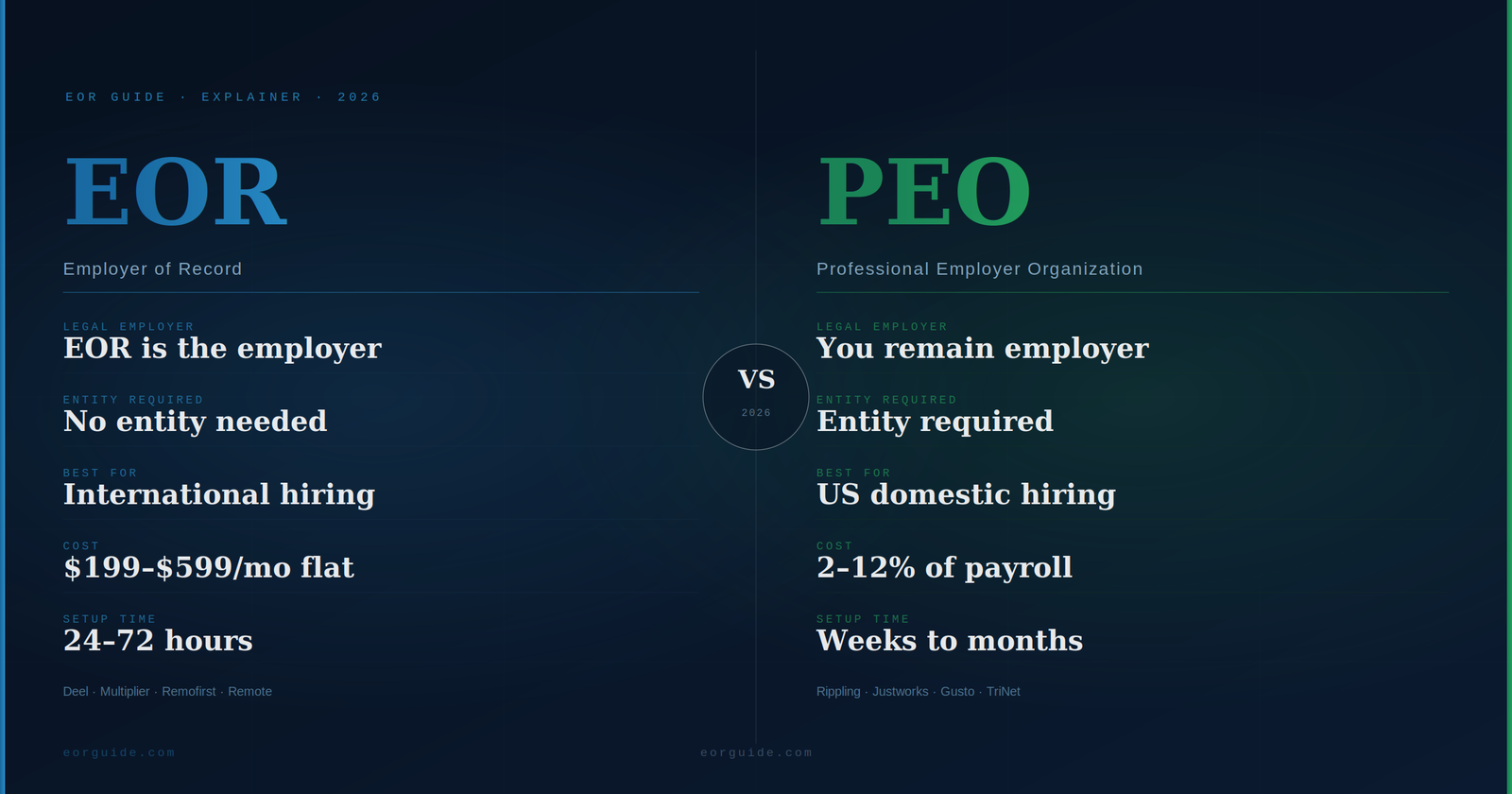
| Feature | EOR | PEO |
|---|---|---|
| Legal employer | EOR is the legal employer | Your company remains the legal employer |
| Entity requirement | No entity required | You must have a legal entity |
| Geographic scope | International | Primarily domestic (US) |
| Compliance responsibility | EOR assumes full responsibility | Shared between you and PEO |
| Best for | International hiring, market entry | Domestic US workforce scaling |
| Cost structure | Flat fee per employee ($199–$599/mo) | 2–12% of payroll or flat fee |
| Setup time | Days | Weeks to months |
| IP ownership | Assigned to your company via contract | Remains with your company |
| Worker classification risk | EOR assumes risk | Shared risk |
What Is an EOR?
An EOR vs PEO comparison starts with understanding what each model actually does. An Employer of Record is a third-party organization that becomes the legal employer of your workforce in a given country. The EOR handles payroll processing, tax withholding, benefits administration, employment contracts, and regulatory compliance in that country.
Your company retains full operational control — you direct the employee’s work, set their goals, manage their performance. The EOR handles the legal and administrative layer.
The EOR model is specifically designed for companies that want to hire talent in countries where they do not have a legal entity. Instead of spending 2–4 months and $10,000–$50,000 setting up a foreign subsidiary, you can have a compliant employee onboarded in 24–72 hours through an EOR.
EOR is the right choice when:
- You want to hire an employee in a country where you have no legal entity
- You are testing a new market before committing to a local subsidiary
- You need to hire internationally quickly — weeks, not months
- You want the EOR to assume full compliance liability in the foreign jurisdiction
- Your team is distributed across multiple countries
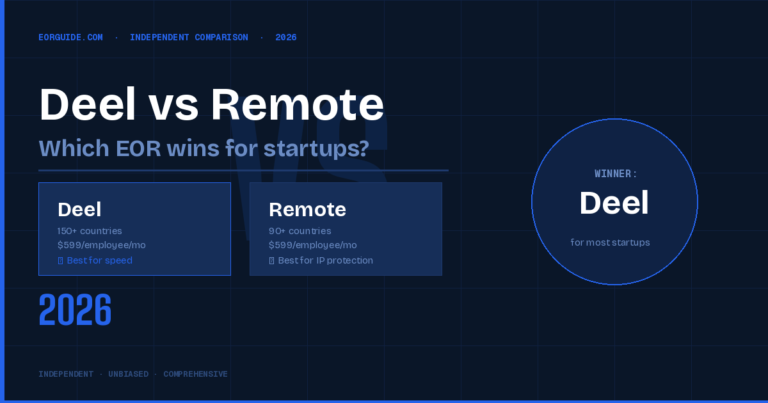
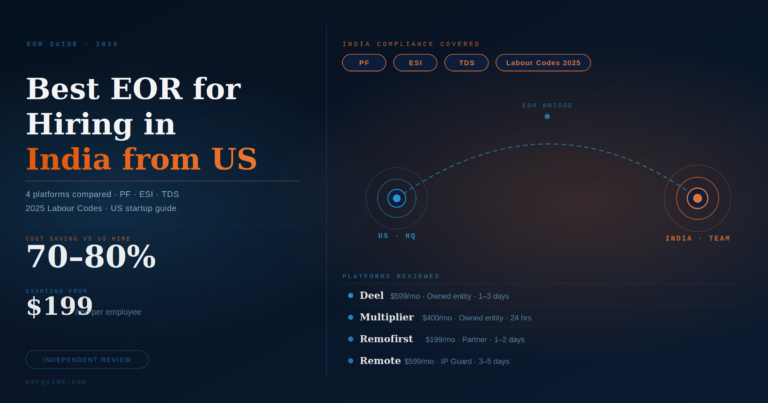
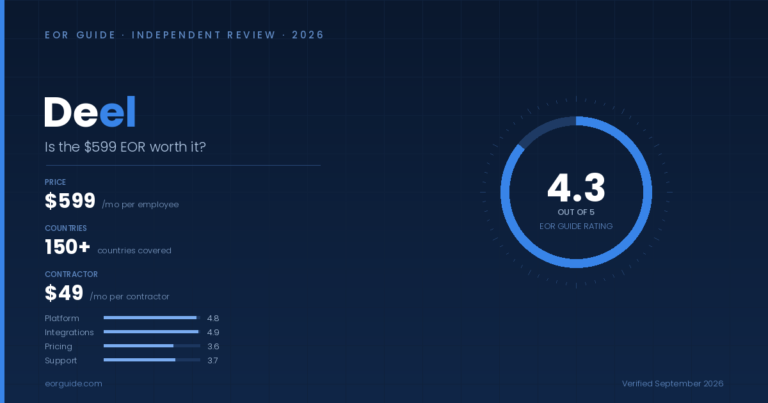
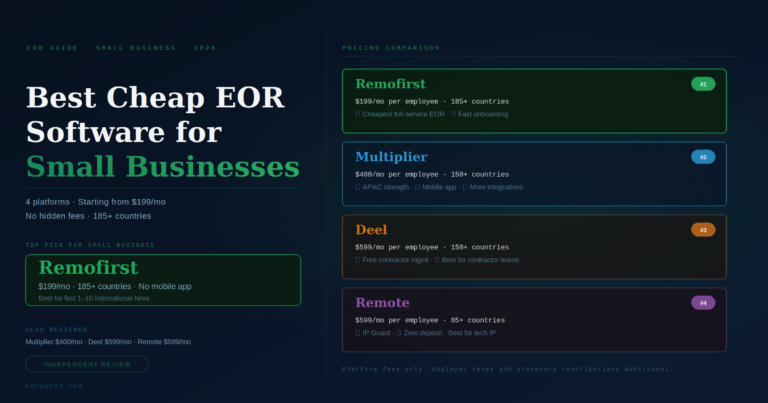
EOR platforms for US startups in 2026: Deel ($599/mo), Multiplier ($400/mo), Remofirst ($199/mo), Remote ($599/mo). See our Best EOR Software for Startups in 2026 guide for a full comparison.
What Is a PEO?
In the EOR vs PEO comparison, a Professional Employer Organization operates under a co-employment model. The PEO enters into a co-employment arrangement with your business — it handles HR administration (payroll, benefits, tax filings, workers’ compensation) while your company remains the legal employer and retains operational control. According to the IRS, a PEO is a co-employer that handles payroll tax obligations on behalf of its clients.
The critical requirement: you must already have a legal entity in the state or country where the workers are based. A PEO cannot help you hire in a country where you have no entity — that is exactly what an EOR is for.
The PEO industry reached $358 billion in revenue in the United States, serving 173,000 businesses with 4.5 million employees. PEOs are particularly valuable for small and mid-sized US businesses that want access to enterprise-level benefits (better health insurance rates, 401k plans) that they could not negotiate independently.
PEO is the right choice when:
- You have a US legal entity and are scaling your domestic workforce
- You want to offer better benefits to US employees without managing them directly
- You need to outsource US payroll, workers’ compensation, and HR compliance
- You want access to enterprise-level health insurance rates as a small company
- Your workforce is primarily US-based
PEO platforms for US startups: Rippling (which offers both PEO and EOR), Justworks, Gusto, TriNet, ADP TotalSource.
EOR vs PEO: Cost Comparison
EOR Costs
EOR pricing is typically a flat monthly fee per employee:
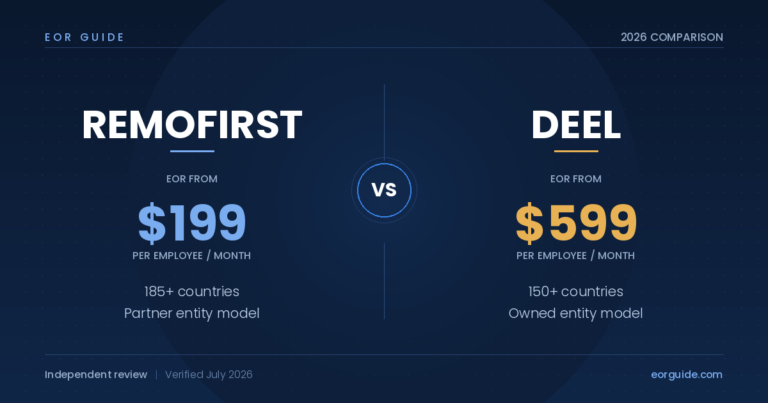
- Remofirst: $199/month per employee
- Multiplier: $400/month per employee
- Deel: $599/month per employee
- Remote: $599/month per employee
The flat fee covers legal employment, payroll, tax compliance, and statutory benefits in the foreign country. No entity setup costs. No ongoing subsidiary maintenance fees.
PEO Costs
PEO pricing typically follows one of two models:
- Percentage of payroll: 2–12% of total payroll (most common for smaller businesses)
- Per employee per month: $100–$200/employee/month for larger teams
For a US company with 20 employees averaging $80,000 salary, a PEO charging 4% of payroll costs approximately $64,000 annually — roughly $267/employee/month. At scale, the percentage model becomes expensive; the flat fee model becomes more cost-effective.
EOR vs PEO cost bottom line: EOR costs more per employee for international hires but eliminates entity setup and maintenance costs. PEO costs less per employee for domestic hires but requires an existing entity and scales with payroll size.
EOR vs PEO: Compliance Responsibility
This is the most important practical difference in the EOR vs PEO comparison for US startup founders.
With an EOR: The EOR assumes full legal compliance responsibility in the foreign jurisdiction. If there is a misclassification issue, a payroll error, or a labour law violation, the EOR is the legal employer and bears primary liability. Your company is protected.
With a PEO: Compliance responsibility is shared. The PEO handles the administrative compliance (payroll tax filings, workers’ compensation, benefits administration) but your company remains the legal employer. If an employment decision leads to a legal claim, your company shares liability with the PEO.
For US startups hiring internationally, the EOR’s assumption of full compliance responsibility is a significant advantage — particularly in markets with complex employment law like India, France, Germany, and Brazil.
Can You Use Both EOR and PEO?
Yes — and many scaling companies do. The most common model is:
- EOR for international hires: Use Deel, Multiplier, or Remofirst to hire in India, Europe, Latin America, and other international markets where you have no entity
- PEO for US domestic hires: Use Rippling, Justworks, or Gusto to manage your US workforce, access better benefits, and outsource US HR administration
Rippling is notable for offering both models in a single platform — EOR for international hires and PEO for US domestic employees — making it the most unified solution for companies with mixed workforces.
EOR vs PEO: Which Is Right for Your Startup?
Choose EOR if:
- You are hiring internationally without a local entity
- You need to hire quickly — days not months
- You want the vendor to assume full compliance liability
- You are testing a new market before entity setup
- Your team is distributed across multiple countries
Choose PEO if:
- You have a US entity and are scaling your domestic workforce
- You want access to better employee benefits at small-company scale
- You need to outsource US payroll and HR administration
- Your team is primarily US-based
Choose both if:
- You have a mix of US domestic employees and international hires
- You are scaling rapidly across multiple jurisdictions simultaneously
For a full comparison of EOR platforms, see our Best EOR Software for Startups in 2026 guide. For remote team hiring, see Best EOR Software for Remote Teams in 2026. For India-specific hiring, see our Best EOR Software for Hiring in India from the US guide.
EOR vs PEO: Frequently Asked Questions
What is the main difference between EOR and PEO? The main EOR vs PEO difference is legal employment. With an EOR, the EOR is the legal employer and assumes full compliance responsibility. With a PEO, your company remains the legal employer and shares compliance responsibility with the PEO. EOR is for international hiring without an entity; PEO is for domestic hiring with an existing entity.
Is EOR more expensive than PEO? EOR typically costs more per employee ($199–$599/month flat fee) than PEO (2–12% of payroll or $100–$200/month). However, EOR eliminates the cost of setting up and maintaining a foreign legal entity ($10,000–$50,000 upfront plus ongoing maintenance), making it more cost-effective for international hiring at early stages.
Can a startup use an EOR in the US? Yes — an EOR can be used to hire employees in the US if your company does not have a US entity. This is uncommon for US-based startups (who typically already have a US entity) but relevant for foreign companies wanting to hire US talent without setting up a US subsidiary.
Do EOR employees get the same benefits as direct employees? Yes — EOR employees receive locally compliant benefits as required by law in their country. Many EOR platforms also offer optional enhanced benefits packages. The employee experience is typically indistinguishable from direct employment.
What is the difference between EOR and PEO for IP protection? With an EOR, IP assignment clauses in the employment contract assign inventions to your company — the EOR is the legal employer but IP belongs to you. With a PEO, you are the legal employer, so IP ownership is straightforward. Both models protect your IP when contracts are correctly structured.
Which is faster — EOR or PEO? EOR is significantly faster. An EOR can onboard an international employee in 24–72 hours. A PEO requires you to already have a legal entity, and setup typically takes weeks. For speed of international market entry, EOR has no comparable alternative.
EOR Guide evaluates platforms independently. We may earn a commission if you sign up through our links, at no extra cost to you. See our How We Review EOR Software and Affiliate Disclosure pages for full details.