Best EOR Software for Startups in 2026
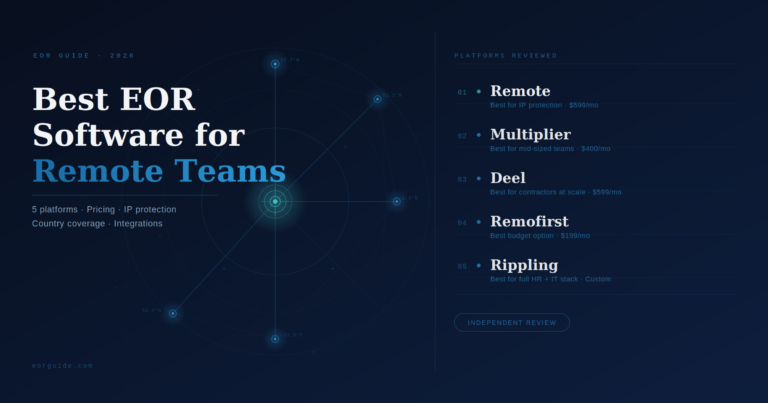
Quick Answer: The best EOR software for startups in 2026 is Deel for most companies — 150+ countries, fast onboarding, and the deepest integration library. Budget-conscious startups should look at Remofirst at $199 per employee per month. For Asia-Pacific hiring, Multiplier at $400 offers the best value.
If you are a startup hiring your first international employee, setting up a legal entity abroad is the last thing you need. It costs $25,000–$100,000 and takes three to six months. The best EOR software for startups solves this — you hire compliantly in days rather than months.
This guide reviews the best EOR software for startups based on verified pricing, country coverage, entity model, onboarding speed and support quality. All figures were checked against provider pricing pages in August 2026.
Best EOR Software for Startups: Our Top Picks
1. Deel — Best Overall for Startups
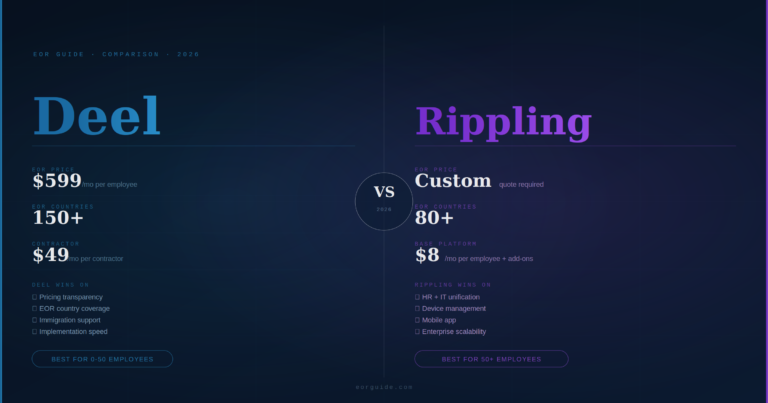
Deel is the market leader and the safest default for most US startups. Coverage spans 150+ countries with entities owned in the majority of them, and the integration library is the deepest in the category.
Pricing: $599 per employee/month ($899 enterprise tier) Contractor management: $49 per contractor/month Countries: 150+ Entity model: Majority owned Best for: Startups hiring across multiple countries with a real tech stack
Pros
- Deepest integration library — 100+ tools plus documented API access
- Onboarding in three to five business days
- Free HRIS tier included
- Adjacent products cover US payroll, PEO, equipment and immigration
Cons
- Premium pricing with no budget tier
- Requires a refundable security deposit, typically one to one and a half times monthly cost per employee
- Can feel heavy for a team making one or two hires
Verdict: If you expect to pass ten international employees within a year and integration gaps would create manual work, Deel earns its price.
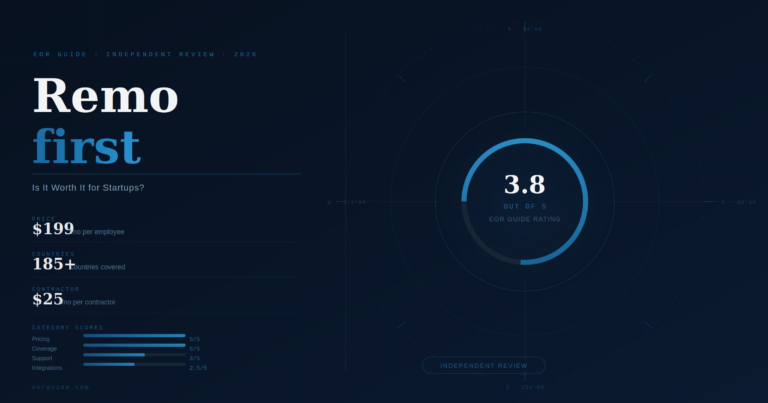
2. Remofirst — Best Budget Option
At $199 per employee per month, Remofirst is the cheapest credible EOR on the market — roughly a third of Deel’s rate. For pre-seed and seed companies watching every dollar, it is the standout.
Pricing: $199 per employee/month Contractor management: Free tier; $25/month for payments Countries: 185+ Entity model: Partner network Best for: Pre-Series A startups making their first international hires
Pros
- Lowest published rate in the category
- Broadest advertised country coverage
- No security deposit, which preserves working capital
- Free contractor management tier
Cons
- Operates through local partners rather than owned entities, so service quality varies by market
- Thin integrations — BambooHR and ADP Workforce Now, then CSV exports
- Younger company with a shorter track record
Verdict: For one to five hires in established markets on a tight budget, Remofirst delivers real value. Read our full Remofirst review before deciding.
3. Multiplier — Best Middle Ground
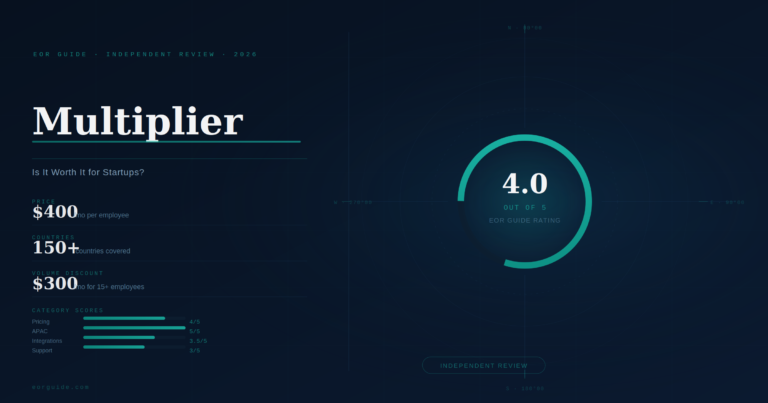
Multiplier sits between the budget and premium tiers at $400, with reported ownership of 100+ legal entities and the fastest onboarding in its price band.
Pricing: $400 per employee/month Contractor management: $40 per contractor/month Countries: 150+ Entity model: Mixed — owned in core markets, partners elsewhere Best for: Startups hiring across Asia-Pacific
Pros
- Onboarding often completes in under 24 hours in owned-entity markets
- Strongest Asia-Pacific coverage and support in its price band
- Visa support and ESOP management included rather than charged as add-ons
- No setup or offboarding fees
Cons
- Roughly 11% of markets carry adjusted pricing above the flat rate — confirm your countries in writing
- Does not publish which countries use owned entities versus partners
- Platform and integrations lag Deel noticeably
Verdict: The best value if your hiring is APAC-weighted. Our Multiplier review covers the entity transparency issue in detail.
4. Remote — Best for Compliance Certainty
Remote owns its legal entities in every country it serves, with no partner intermediaries anywhere. For startups with sensitive IP or board-level compliance concerns, that certainty matters.
Pricing: $699 per employee/month billed monthly; $599 on annual commitment Contractor management: $29 per contractor/month Countries: 90+ Entity model: 100% owned Best for: Tech startups with IP exposure or regulated-industry requirements
Pros
- Every market runs through an owned entity — no third-party risk
- Strongest IP and data protection position in the category
- No security deposit required
- Cheaper contractor management than Deel
Cons
- Narrowest country coverage of the providers here
- Highest monthly rate unless you commit annually
- Fewer integrations than Deel
Verdict: Worth the premium if compliance depth outweighs coverage breadth for your situation.
5. Rippling — Best All-in-One Platform
Rippling combines global hiring with domestic HR, IT provisioning and finance in a single system. For startups that want one platform rather than a stack, nothing else comes close.
Pricing: Not published. Third-party estimates put EOR at $499–$599 per employee/month, on top of an $8 per-user base platform fee Countries: 140+ Entity model: Mixed Best for: Post-Series A startups consolidating HR, IT and payroll
Pros
- Unified HR, IT and finance in one system
- Strongest automation and workflow tooling
- Scales from ten to ten thousand employees
Cons
- No published EOR pricing — every figure is an estimate until you get a quote
- Implementation fees reported from $1,500 to $15,000 depending on complexity
- Modular add-ons stack cost quickly
- Overkill at early stage
Verdict: Excellent if you are already a Rippling customer. Get pricing in writing before committing, since nothing is public.
Best EOR Software for Startups: Pricing Compared
Platform fees across the best EOR software for startups vary by more than three times. Here is what each provider charges as of August 2026.
| Provider | EOR / employee / month | Contractor / month | Countries | Entity model |
|---|---|---|---|---|
| Remofirst | $199 | Free tier; $25 paid | 185+ | Partner network |
| Multiplier | $400 | $40 | 150+ | Mixed |
| Oyster | From $499 | $29 | 180+ | Mixed |
| Rippling | $499–$599 + $8 base | Not published | 140+ | Mixed |
| Deel | $599 | $49 | 150+ | Majority owned |
| Remote | $699 monthly; $599 annual | $29 | 90+ | 100% owned |
Verified August 2026 against the published pricing pages for Remofirst, Deel and Remote, plus third-party analyses for providers that do not publish rates.
The gap between cheapest and most expensive is $500 per employee per month — $6,000 a year on a single hire, $30,000 across five. At seed stage that is a meaningful line item.
But the platform fee is the smallest part of what you pay. Employer taxes and statutory contributions add 13–40% on top of salary depending on country. On a $70,000 engineer in Germany, that is over $20,000 annually before the platform fee. We track current rates across twelve providers in our EOR Pricing Index.
How to Choose the Best EOR Software for Startups
Most guides rank providers on features. For a startup, four things actually decide the outcome.
Entity ownership in your specific countries. Providers advertise 150 or 185 countries, but few own entities everywhere — the rest use local partners. With an owned entity, your provider is the legal employer and carries liability directly. With a partner, a third company holds that relationship and your service quality depends on them. Ask in writing which model applies to each country you plan to hire in.
Onboarding speed. Ranges from under 24 hours to over two weeks depending on provider and market. If a delayed start date costs you a candidate, this matters more than a $200 monthly difference.
Integration depth. Below roughly ten international employees, thin integrations cost almost nothing. Past fifteen or twenty, manual reconciliation consumes more finance-team hours than the cheaper platform saved. Know which side of that line you are on.
The costs nobody publishes. FX spread runs 0.5–2% and is rarely itemised — on $500,000 of annual payroll, two percent is $10,000, enough to reverse the ranking between two providers. Security deposits are the other one, and they tie up working capital you may need elsewhere.
Best EOR Software for Startups by Stage
The best EOR software for startups changes as you grow. Here is how the shortlist shifts by stage.
Pre-seed and seed, one to five hires. Budget is the binding constraint and your systems are simple. Remofirst at $199 handles straightforward hires in established markets, and the absence of a deposit matters when cash is tight.
Seed to Series A, five to fifteen hires. The middle tier earns its price, particularly with regional concentration. Multiplier at $400 is strong for Asia-Pacific and onboards faster than most.
Series A and beyond, fifteen or more hires. Integration gaps now cost real money in finance hours, and Deel’s platform depth typically justifies the fee. If compliance certainty is a board-level concern, Remote’s owned-entity model is worth the premium despite narrower coverage.
The mistake we see most often is buying enterprise-tier software at seed stage because it is the recognised name, then paying for integrations nobody uses. The second most common is staying on the cheapest option past thirty employees while quietly burning finance hours to save a fee that stopped being material.
Why Startups Need EOR Software in 2026
Distributed hiring is now standard rather than exceptional, and the compliance burden that comes with it does not scale down for small companies. Hiring one engineer in Poland carries the same statutory obligations as hiring fifty.
Without an EOR, three risks apply immediately:
- Misclassification penalties. Treating employees as contractors can result in six-figure fines, and most countries define contractor far more narrowly than US companies assume.
- Payroll compliance failures. Each country sets its own tax, benefits and notice-period rules, and errors compound quietly until an audit.
- Slow hiring. Entity setup takes three to six months, which loses you candidates to faster competitors.
An EOR removes all three by becoming the legal employer while you manage the work.
Frequently Asked Questions
What is EOR software?
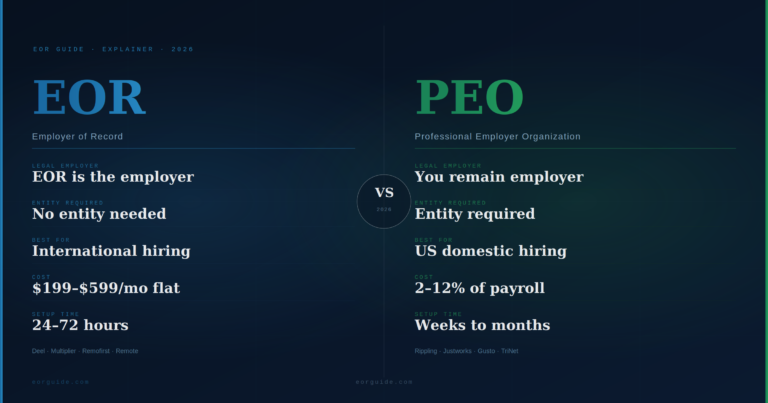
An Employer of Record legally employs workers on your behalf in a country where you have no entity. You direct the work; they handle the contract, payroll, taxes, benefits and compliance liability.
How much does EOR software cost?
Published platform fees range from $199 to $699 per employee per month. Remofirst is cheapest at $199, Deel lists $599, and Remote is $699 monthly or $599 on an annual commitment. None of these include salary or employer taxes.
Is EOR legal in the US?
Yes. EOR arrangements are legal and widely used by US companies hiring internationally without foreign entities.
How long does it take to hire through an EOR?
Most platforms onboard in three to seven business days. Multiplier is often faster in owned-entity markets. Traditional entity setup takes three to six months.
Can I switch EOR providers later?
Yes. Most providers require no annual contract and charge no termination fees. Switching means re-onboarding employees under a new legal employer — administratively real but routine.
Best EOR Software for Startups: Our Verdict
After comparing all five platforms, the best EOR software for startups depends on your stage and where you are hiring.
Deel wins overall for companies with mature systems and multi-country hiring. Remofirst wins on price for early-stage teams making their first hires. Multiplier wins on value for Asia-Pacific. Remote wins where compliance certainty outweighs coverage. Rippling wins if you want a single platform and are already in its ecosystem.
Get written quotes from two providers covering your actual countries, and make each state the FX spread, any country surcharge and any deposit requirement explicitly. That document will tell you more than any comparison guide, including this one.
Our review methodology explains how we assess every provider.
EOR Guide Editorial Team. Pricing verified August 2026 against provider pricing pages. Vendor terms change frequently — confirm current rates before purchasing. Last updated: August 2026.
Quick Answer: The best EOR software for startups in 2026 is Deel for most companies — 150+ countries, fast onboarding, and the deepest integration library. Budget-conscious startups should look at Remofirst at $199 per employee per month. For Asia-Pacific hiring, Multiplier at $400 offers the best value.
If you are a startup hiring your first international employee, setting up a legal entity abroad is the last thing you need. It costs $25,000–$100,000 and takes three to six months. Employer of Record software solves this — you hire compliantly in days rather than months.
This guide reviews the best EOR software for startups based on verified pricing, country coverage, entity model, onboarding speed and support quality. All figures were checked against provider pricing pages in August 2026.
Best EOR Software for Startups: Our Top Picks
1. Deel — Best Overall for Startups
Deel is the market leader and the safest default for most US startups. Coverage spans 150+ countries with entities owned in the majority of them, and the integration library is the deepest in the category.
Pricing: $599 per employee/month ($899 enterprise tier) Contractor management: $49 per contractor/month Countries: 150+ Entity model: Majority owned Best for: Startups hiring across multiple countries with a real tech stack
Pros
- Deepest integration library — 100+ tools plus documented API access
- Onboarding in three to five business days
- Free HRIS tier included
- Adjacent products cover US payroll, PEO, equipment and immigration
Cons
- Premium pricing with no budget tier
- Requires a refundable security deposit, typically one to one and a half times monthly cost per employee
- Can feel heavy for a team making one or two hires
Verdict: If you expect to pass ten international employees within a year and integration gaps would create manual work, Deel earns its price.
2. Remofirst — Best Budget Option
At $199 per employee per month, Remofirst is the cheapest credible EOR on the market — roughly a third of Deel’s rate. For pre-seed and seed companies watching every dollar, it is the standout.
Pricing: $199 per employee/month Contractor management: Free tier; $25/month for payments Countries: 185+ Entity model: Partner network Best for: Pre-Series A startups making their first international hires
Pros
- Lowest published rate in the category
- Broadest advertised country coverage
- No security deposit, which preserves working capital
- Free contractor management tier
Cons
- Operates through local partners rather than owned entities, so service quality varies by market
- Thin integrations — BambooHR and ADP Workforce Now, then CSV exports
- Younger company with a shorter track record
Verdict: For one to five hires in established markets on a tight budget, Remofirst delivers real value. Read our full Remofirst review before deciding.
3. Multiplier — Best Middle Ground
Multiplier sits between the budget and premium tiers at $400, with reported ownership of 100+ legal entities and the fastest onboarding in its price band.
Pricing: $400 per employee/month Contractor management: $40 per contractor/month Countries: 150+ Entity model: Mixed — owned in core markets, partners elsewhere Best for: Startups hiring across Asia-Pacific
Pros
- Onboarding often completes in under 24 hours in owned-entity markets
- Strongest Asia-Pacific coverage and support in its price band
- Visa support and ESOP management included rather than charged as add-ons
- No setup or offboarding fees
Cons
- Roughly 11% of markets carry adjusted pricing above the flat rate — confirm your countries in writing
- Does not publish which countries use owned entities versus partners
- Platform and integrations lag Deel noticeably
Verdict: The best value if your hiring is APAC-weighted. Our Multiplier review covers the entity transparency issue in detail.
4. Remote — Best for Compliance Certainty
Remote owns its legal entities in every country it serves, with no partner intermediaries anywhere. For startups with sensitive IP or board-level compliance concerns, that certainty matters.
Pricing: $699 per employee/month billed monthly; $599 on annual commitment Contractor management: $29 per contractor/month Countries: 90+ Entity model: 100% owned Best for: Tech startups with IP exposure or regulated-industry requirements
Pros
- Every market runs through an owned entity — no third-party risk
- Strongest IP and data protection position in the category
- No security deposit required
- Cheaper contractor management than Deel
Cons
- Narrowest country coverage of the providers here
- Highest monthly rate unless you commit annually
- Fewer integrations than Deel
Verdict: Worth the premium if compliance depth outweighs coverage breadth for your situation.
5. Rippling — Best All-in-One Platform
Rippling combines global hiring with domestic HR, IT provisioning and finance in a single system. For startups that want one platform rather than a stack, nothing else comes close.
Pricing: Not published. Third-party estimates put EOR at $499–$599 per employee/month, on top of an $8 per-user base platform fee Countries: 140+ Entity model: Mixed Best for: Post-Series A startups consolidating HR, IT and payroll
Pros
- Unified HR, IT and finance in one system
- Strongest automation and workflow tooling
- Scales from ten to ten thousand employees
Cons
- No published EOR pricing — every figure is an estimate until you get a quote
- Implementation fees reported from $1,500 to $15,000 depending on complexity
- Modular add-ons stack cost quickly
- Overkill at early stage
Verdict: Excellent if you are already a Rippling customer. Get pricing in writing before committing, since nothing is public.
Best EOR Software for Startups: Pricing Compared
| Provider | EOR / employee / month | Contractor / month | Countries | Entity model |
|---|---|---|---|---|
| Remofirst | $199 | Free tier; $25 paid | 185+ | Partner network |
| Multiplier | $400 | $40 | 150+ | Mixed |
| Oyster | From $499 | $29 | 180+ | Mixed |
| Rippling | $499–$599 + $8 base | Not published | 140+ | Mixed |
| Deel | $599 | $49 | 150+ | Majority owned |
| Remote | $699 monthly; $599 annual | $29 | 90+ | 100% owned |
Verified August 2026 against provider pricing pages.
The gap between cheapest and most expensive is $500 per employee per month — $6,000 a year on a single hire, $30,000 across five. At seed stage that is a meaningful line item.
But the platform fee is the smallest part of what you pay. Employer taxes and statutory contributions add 13–40% on top of salary depending on country. On a $70,000 engineer in Germany, that is over $20,000 annually before the platform fee. We track current rates across twelve providers in our EOR Pricing Index.
How to Choose the Best EOR Software for Startups
Most guides rank providers on features. For a startup, four things actually decide the outcome.
Entity ownership in your specific countries. Providers advertise 150 or 185 countries, but few own entities everywhere — the rest use local partners. With an owned entity, your provider is the legal employer and carries liability directly. With a partner, a third company holds that relationship and your service quality depends on them. Ask in writing which model applies to each country you plan to hire in.
Onboarding speed. Ranges from under 24 hours to over two weeks depending on provider and market. If a delayed start date costs you a candidate, this matters more than a $200 monthly difference.
Integration depth. Below roughly ten international employees, thin integrations cost almost nothing. Past fifteen or twenty, manual reconciliation consumes more finance-team hours than the cheaper platform saved. Know which side of that line you are on.
The costs nobody publishes. FX spread runs 0.5–2% and is rarely itemised — on $500,000 of annual payroll, two percent is $10,000, enough to reverse the ranking between two providers. Security deposits are the other one, and they tie up working capital you may need elsewhere.
Best EOR Software for Startups by Stage
Pre-seed and seed, one to five hires. Budget is the binding constraint and your systems are simple. Remofirst at $199 handles straightforward hires in established markets, and the absence of a deposit matters when cash is tight.
Seed to Series A, five to fifteen hires. The middle tier earns its price, particularly with regional concentration. Multiplier at $400 is strong for Asia-Pacific and onboards faster than most.
Series A and beyond, fifteen or more hires. Integration gaps now cost real money in finance hours, and Deel’s platform depth typically justifies the fee. If compliance certainty is a board-level concern, Remote’s owned-entity model is worth the premium despite narrower coverage.
The mistake we see most often is buying enterprise-tier software at seed stage because it is the recognised name, then paying for integrations nobody uses. The second most common is staying on the cheapest option past thirty employees while quietly burning finance hours to save a fee that stopped being material.
Why Startups Need EOR Software in 2026
Distributed hiring is now standard rather than exceptional, and the compliance burden that comes with it does not scale down for small companies. Hiring one engineer in Poland carries the same statutory obligations as hiring fifty.
Without an EOR, three risks apply immediately:
- Misclassification penalties. Treating employees as contractors can result in six-figure fines, and most countries define contractor far more narrowly than US companies assume.
- Payroll compliance failures. Each country sets its own tax, benefits and notice-period rules, and errors compound quietly until an audit.
- Slow hiring. Entity setup takes three to six months, which loses you candidates to faster competitors.
An EOR removes all three by becoming the legal employer while you manage the work.
Frequently Asked Questions
What is EOR software?
An Employer of Record legally employs workers on your behalf in a country where you have no entity. You direct the work; they handle the contract, payroll, taxes, benefits and compliance liability.
How much does EOR software cost?
Published platform fees range from $199 to $699 per employee per month. Remofirst is cheapest at $199, Deel lists $599, and Remote is $699 monthly or $599 on an annual commitment. None of these include salary or employer taxes.
Is EOR legal in the US?
Yes. EOR arrangements are legal and widely used by US companies hiring internationally without foreign entities.
How long does it take to hire through an EOR?
Most platforms onboard in three to seven business days. Multiplier is often faster in owned-entity markets. Traditional entity setup takes three to six months.
Can I switch EOR providers later?
Yes. Most providers require no annual contract and charge no termination fees. Switching means re-onboarding employees under a new legal employer — administratively real but routine.
Best EOR Software for Startups: Our Verdict
After comparing all five platforms, the best EOR software for startups depends on your stage and where you are hiring.
Deel wins overall for companies with mature systems and multi-country hiring. Remofirst wins on price for early-stage teams making their first hires. Multiplier wins on value for Asia-Pacific. Remote wins where compliance certainty outweighs coverage. Rippling wins if you want a single platform and are already in its ecosystem.
Get written quotes from two providers covering your actual countries, and make each state the FX spread, any country surcharge and any deposit requirement explicitly. That document will tell you more than any comparison guide, including this one.
Our review methodology explains how we assess every provider.
EOR Guide Editorial Team. Pricing verified August 2026 against provider pricing pages. Vendor terms change frequently — confirm current rates before purchasing. Last updated: August 2026.