Remofirst vs Deel (2026): Which EOR Is Right for Your Startup?
If you are choosing between Remofirst vs Deel, you are really choosing between two different philosophies of global employment. One is built to be the cheapest compliant way to put someone on payroll overseas. The other is built to be the operating system for your entire international workforce — and it charges accordingly.
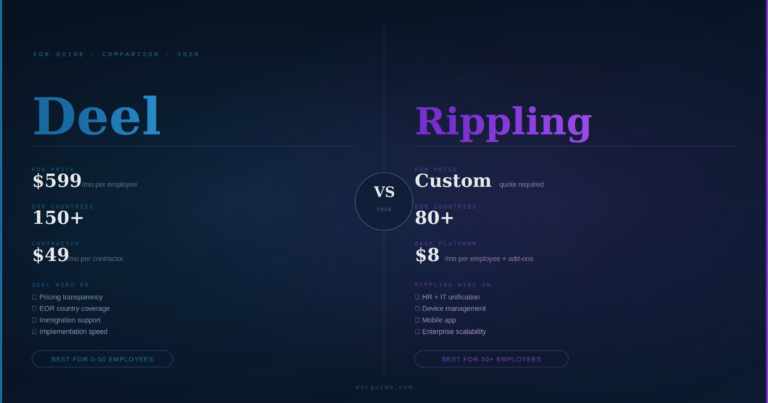
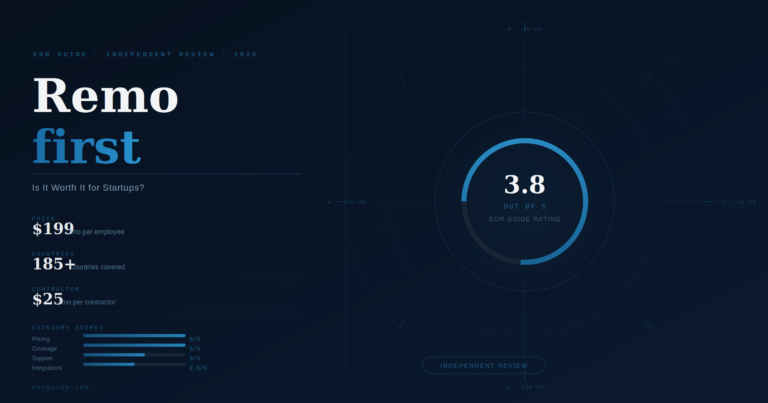
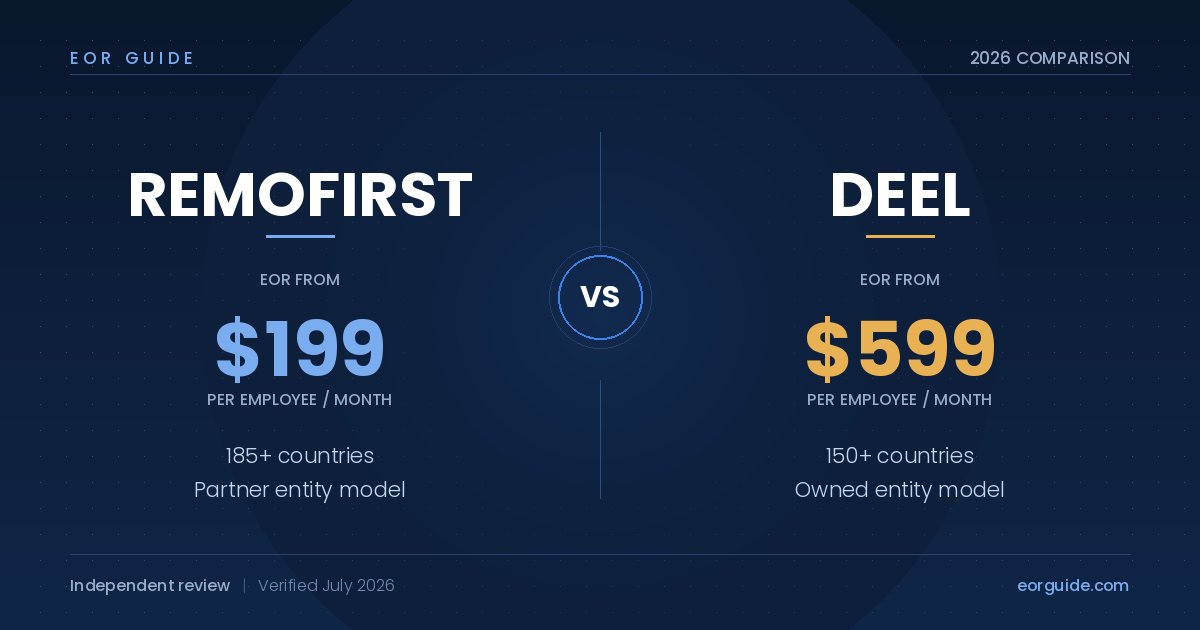
The price gap is not small. Deel’s published Employer of Record rate is $599 per employee per month. Remofirst’s is $199. Over a year, on a single hire, that is a $4,800 difference in platform fees alone. On five hires, it is $24,000 — roughly a junior engineer’s quarterly salary.
That gap is the entire decision. This comparison breaks down what you actually give up at the lower price point, and when paying three times more is the rational choice.
Quick verdict: Choose Remofirst if you are hiring one to five people internationally, your budget is tight, and your HR stack is simple. Choose Deel if you already run a real tech stack, expect to scale past ten international employees, or are hiring into complex jurisdictions where compliance depth matters more than monthly fees.
Remofirst vs Deel: Side-by-Side Comparison
| Remofirst | Deel | |
|---|---|---|
| EOR price (published) | $199 per employee/month | $599 per employee/month |
| Contractor management | Free tier; $25/month for payments | $49 per contractor/month |
| Global payroll (own entity) | Not a core product | $29 per employee/month |
| Country coverage | 185+ countries | 150+ countries |
| Entity model | Partner network | Majority owned entities |
| Security deposit | None | Approx. 1–1.5x monthly cost |
| Setup / termination fees | None | None published |
| Free HRIS included | No | Yes (Deel HR) |
| Integrations | BambooHR, ADP Workforce Now | Extensive (HRIS, ATS, accounting, API) |
| Visa & immigration | RemoVisa, 85+ countries | Custom-quoted per case |
| Minimum contract | None | None published |
Pricing verified July 2026 against the Remofirst pricing page and Deel pricing page. EOR fees are platform charges only and exclude salary, employer taxes, and statutory benefits.
Remofirst vs Deel Pricing: The $400 Gap Explained
The headline numbers are the least useful figures in this comparison, because neither includes what you will actually pay.
For any EOR hire, your real monthly cost is the platform fee plus gross salary plus employer taxes and statutory contributions. Those statutory costs run roughly 15% to 45% of salary depending on country. On a $60,000 hire in Germany, employer contributions alone can add $12,000 or more annually. The platform fee is often under 10% of the total invoice.
That reframes the Remofirst vs Deel pricing question. You are not comparing $199 against $599 as a share of your budget — you are comparing them as a share of a much larger number where both are a minority line item.
Where the gap still matters:
Volume changes the maths. Deel’s list price drops to roughly $400–$500 per employee at 20 or more headcount. Remofirst reportedly negotiates down to $129–$149 at 50+. The proportional gap holds, but the absolute difference at scale becomes large enough to fund additional headcount.
Deel holds a deposit. Deel typically requires a refundable security deposit of about one to one and a half times the monthly cost per employee before your first payroll run, with higher requirements in markets including France, Germany, the Netherlands, and Israel. It is returned after offboarding, but it ties up working capital. Remofirst does not require one. For a pre-Series A company, that cash flow difference can matter more than the monthly fee.
Both take an FX cut. Deel discloses a currency conversion markup in the 0.6% to 2% range on cross-border payments. On $500,000 of annual payroll, a 2% spread is $10,000 — enough to erase a meaningful share of any headline saving. Verify the spread with both vendors before signing, because it is rarely itemised on invoices.
Country surcharges are the asterisk. Deel does not publish country-level pricing, and complex markets such as Brazil, France, and India can carry surcharges of $50–$150 per employee per month above the base rate. Remofirst markets a flat rate across all countries, though some third-party reviews report higher effective rates in markets like the UK and Canada. Get a written quote for your specific countries from both.
For a fuller breakdown of what drives total spend, see our guide to how much EOR software costs.
Country Coverage and the Entity Model Difference
On paper Remofirst wins coverage, 185+ countries against Deel’s 150+. In practice this is the most misleading line in any Remofirst vs Deel comparison, because the two companies count differently.
Deel owns legal entities in the majority of the countries it serves. When Deel is your EOR, Deel is typically the legal employer, holding the contract and carrying the liability directly.
Remofirst operates primarily through a partner network. A local partner in each market acts as the employing entity. This is what allows Remofirst to offer wide coverage at a low price without the capital cost of incorporating in 185 jurisdictions.
Neither model is wrong, but they fail differently. With owned entities, service quality is consistent because one company controls it. With a partner model, your experience in Portugal may be excellent and your experience in Nigeria may not, because they are different organisations operating under one brand. If something goes wrong — a misclassified termination, a disputed statutory payment — the partner model adds a party between you and the resolution.
The practical rule: for straightforward hires in established markets, the partner model is usually fine and you are paying a real premium for owned entities you do not need. For hires in jurisdictions with aggressive labour enforcement, or for roles where a termination dispute is plausible, direct liability is worth paying for.
Platform, Integrations, and Day-to-Day Use
This is where the Remofirst vs Deel gap is widest, and it is not close.
Deel functions as a full platform. It includes a free HRIS tier, connects to major HR systems, applicant tracking tools, and accounting platforms, and offers documented API access. It also sells adjacent products — US payroll, US PEO, equipment provisioning, immigration support — which means one vendor can cover a growing company’s whole employment stack.
Remofirst is a focused EOR tool. The dashboard is clean and reviewers consistently describe onboarding as fast and low-friction. But integration coverage is thin: BambooHR and ADP Workforce Now are supported, and beyond that you are exporting CSVs. There is no public API documentation comparable to Deel’s.
The cost of that is measured in hours, not dollars. If you run five international employees and reconcile payroll monthly in a spreadsheet, thin integrations cost you almost nothing. If you run thirty and your finance team syncs headcount data to NetSuite, manual reconciliation will quietly consume more value than the fee saving delivers.
That crossover point — where admin overhead exceeds the price difference — typically arrives somewhere between fifteen and thirty international employees, depending on how mature your systems are.
Support and Onboarding Speed
Both providers offer 24/7 support and dedicated account management. Remofirst guarantees a sales response within fifteen minutes and has invested visibly in responsiveness — it was named a Leader in NelsonHall’s NEAT evaluation for Global EOR Services in September 2025, notable for a provider at its price point.
Deel’s support organisation is larger and its coverage more consistent across time zones, which matters when a payroll question in Singapore cannot wait for European business hours. Deel has also drawn recurring user criticism for platform performance and for support quality degrading as the company scaled.
Onboarding timelines are comparable, generally one to two weeks in established markets for both. Complex jurisdictions extend that for either provider.
Remofirst vs Deel: Which Should You Choose?
Choose Remofirst if:
- You are making your first one to five international hires
- Budget is a genuine constraint and the saving funds something else
- You are hiring into established markets with straightforward employment law
- Your HR stack is simple, or you already run BambooHR
- You want to avoid a security deposit tying up cash
- You need contractor management alongside EOR and want the free tier
Choose Deel if:
- You expect to pass ten to fifteen international employees within a year
- You run a real tech stack and integration gaps would create manual work
- You are hiring into jurisdictions with complex or aggressively enforced labour law
- You want a single vendor across EOR, payroll, US PEO, and equipment
- You are venture-backed and administrative reliability outweighs monthly cost
- You need documented API access
If you are still deciding between models rather than vendors, our EOR vs PEO comparison covers which structure fits your situation. For a broader shortlist, see our best EOR software for startups rankings.
Remofirst vs Deel FAQ
Is Remofirst really cheaper than Deel?
Yes, on published platform fees. Remofirst lists $199 per employee per month against Deel’s $599, and Remofirst charges no security deposit. But platform fees are typically under 10% of your total employment cost once salary and employer taxes are included, so the practical saving is smaller as a share of budget than the headline gap suggests.
Is Remofirst safe to use for compliance?
Remofirst generates locally compliant employment contracts and manages statutory obligations through its partner network. The compliance risk is not that the model is unsound — it is that quality depends on the local partner rather than on Remofirst directly. Ask which partner handles your specific country and how disputes are escalated.
Which is better for hiring in one country only?
For a single hire in an established market, Remofirst is usually the better value in a Remofirst vs Deel comparison. The features Deel charges for — integrations, breadth of adjacent products, owned entities across 150 countries — deliver little when you have one employee in one country.
Can I switch from Remofirst to Deel later?
Yes. Neither provider requires an annual contract or charges termination fees. Switching does mean re-onboarding employees under a new legal employer, which is administratively real but routine. Starting on Remofirst and migrating at scale is a defensible strategy.
Does Deel or Remofirst handle US employees?
Deel offers US payroll and a US PEO product for domestic employees. Remofirst is built for international hiring and is not the right tool for US-based staff. If your requirement is primarily domestic, neither EOR product is the answer.
The Bottom Line
The Remofirst vs Deel decision comes down to a single question: is your constraint money or time?
Remofirst is the correct answer for early-stage companies where $400 per employee per month is a real number and administrative overhead is absorbed by a founder who is already doing five jobs. It is a serious, credible EOR at a price nobody else in its tier matches.
Deel is the correct answer once your international headcount and systems maturity mean manual work costs more than the premium. It is not a better version of Remofirst — it is a different product, sold to a company at a different stage.
The mistake we see most often is companies buying Deel at seed stage because it is the recognised name, then paying enterprise pricing for integrations they do not use. The second most common mistake is staying on Remofirst past thirty international employees and quietly burning finance team hours to save a fee that stopped being material.
Get written quotes from both for your specific countries, including FX spread and any country surcharge, before deciding. Published rates rarely survive contact with an actual hiring plan.
For a deeper look at Remofirst on its own terms, read our full Remofirst review. Our review methodology explains how we assess every provider.
EOR Guide Editorial Team. Pricing and feature information verified July 2026 against the Remofirst pricing page and Deel pricing page and third-party analyses. Vendor terms change frequently — confirm current rates directly before purchasing. EOR Guide may earn a commission from providers featured on this page. This does not influence our assessments or rankings.